They aren’t swear words. But Noel has his, and I have mine.
They are our verbal duelling swords. Each is sharp and effective at putting a shiver of fear up each others’ spine.
It’s a new tactic for Noel. Whenever I say, “I have an idea.” He stuffs his fingers right in to his ears and sings as loudly as he can, until I get the hump and say, rather sulkily, “Right, I’m not telling you now.” Which is, of course, his desired effect.
Don’t let the innocent face fool you!
So, in addition to this tactic, whenever I mention my B word, he slinks off and starts researching his B word.
Have you guessed them yet? Mine is Books and his is Boats!
Image courtesy of Supertrooper at FreeDigitalPhotos.net
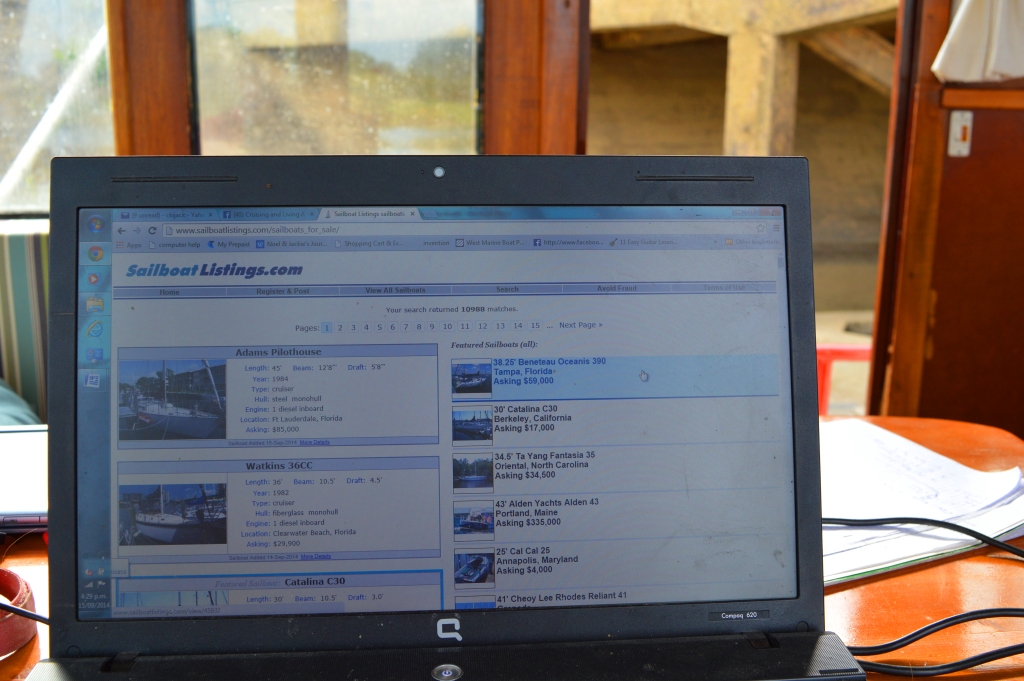
When I was talking about more book ideas yesterday, Noel went very quiet and I caught him looking up sailboats for sale!!
With 50 years combined professional and personal knowledge and thousands of ocean miles, we still spent two years searching on the internet (while working on shore) before viewing boats (in San Francisco) and purchasing our second boat, Pyewacket II. Join groups in FB, cruising web-pages and read blogs that are relevant to your situation – ask questions, keep asking questions. Read, read, read.
But, usually, the longer the boat the more cost involved, more antifoul, heavier/longer rigging., etc, but with care & knowledge it doesn’t have to be too much more. Owning and maintaining a boat that is already in a seaworthy condition is pretty much a full time job. If you want to go cruising sooner rather than later, you do not have time for a major fixer-upper.
How much work do you want to do before you GO cruising?
3) Is it better to buy a boat from a broker or privately?
You may not have a choice. We purchased both our boats privately and sold them privately too. In the past, we thought that brokers charged too much for their service. However, we sold our friends’ sailboat on their behalf and quickly found out that doing a good job of selling a boat is an incredible amount of work. If the boat you want is for sale via a broker, do some research on the broker – be prepared. But, try to form your own opinions on the broker and remember when you are buying, the broker will be looking out for the seller (who is employing him). If you are buying privately carry out relevant checks (see below).
4) If a boat seems cheap, ask yourself why?
Is it just circumstance? Is it the market? Or is there a problem that needs addressing. Keep this in mind when viewing.
5) Verification of details
If you are buying a boat, research and verification of all the detail is extremely important and if it is all new to you, ask a friend who has some knowledge to help. If you are buying privately, we recommend that you hire the services of professional document advisers/escrow agent.
Verify:
What equipment is being left on board
Who is paying for what during survey (paint, additional work that is necessary while on the hard) – make sure this is ALL clear
There is no money owing on the boat
The owners ARE the owners
Timeline for everything to happen succinctly (booking haul, surveyor out etc)
Can you have your deposit returned at survey stage if you are not happy for any reason?
6) How do you view a boat?
We viewed many boats and we were always startled by so many differences.
There is never a foolish question, Ask, ask, ask – research, research, research.
Check everything works
Start the engine, watch it working
Try the bed, enough room for you?
Stand at the sink – are you comfortable?
Find the reason why there is oil under the engine or water in the bilge.
Do the heads flush properly?
Sample the water on board, it is a good indication of the state of the tanks.
It is imperative that you choose your own surveyor
Is it seaworthy?
7) Technical specs
Ask lots of questions about the boat. Some of the most important things to know are:
Its condition, is it seaworthy?
The length over all (LOA)
Displacement (weight)
Draft (how deep the water must be in order to sail)
Age of the vessel
Number and types of sails on board
Be sure to ask if there’s any equipment that is presently on the boat that will be removed by the owner prior to the sale. For example, some owners will remove electronics like televisions, GPS systems, and even radios.
How regularly are the batteries charged/maintained
Is there a maintenance log book available for the engine?
At survey, you could have an engine oil analysis done (if available).
8) How many viewings? A test sail?
We always arranged a second and third visit to boats that interested us. You must spend time on board, you are not wasting people’s time if you are genuinely interested in the vessel. If we felt rushed when looking at a boat (or were constantly distracted by the broker/seller) – we viewed this as a red flag and thought there were problems that were being hidden. When we purchased our boats and when we sold our boats, the agreement was:
A test sail was arranged after the deposit was received (usually 10%)
The deposit was refundable if the test sail didn’t ‘work’(!)
The deposit is a good faith payment that helps filter out time-wasters wanting a day on the water
The deposit made the potential purchaser responsible, not so gung-ho!
9) Keep Track
If you are viewing several boats, take pictures of each. Start with the name and a full picture, then take pictures as you go through the vessel, otherwise they will all blend in to one. An organised notebook helps too. Jot down what you liked and disliked for later reference.
Finalise the test sail detail prior to going… how long, how far, deposit?
10) Buying the right boat
Try to restrain your emotions. While you should listen to your heart, you must follow up with your brain and acquired knowledge or your bank balance could get hurt and your safety may be compromised. Do thorough research. However, eventually your emotions will play a part.
Be broadminded and prepared to look at something you hadn’t considered previously. We started looking for something in the mid 40ft range and ended up with a 51 footer.
Cost considerations should span out to marinas or moorings. Do some research on this if you are interested in a boat in a specific area. You will need to haul it out for a survey (at your expense). It is quite likely you will have to update safety equipment: Fire extinguishers, EPRIBs, safety equipment, life jackets etc.,
Don’t forget registration will have to be transferred, this can be a sizeable expense at times.
11) Surveyor
We had all our boats surveyed. A surveyor will help verify the value of the boat and the potential expense involved in any restoration. AND highlight problems.
12) International purchase
If you are purchasing a boat in another country, research the import duty for taking it home and any tax implications in the country you purchased the boat.
13) Make an offer
Brokers will pass on any offer, it is not up to them to turn it down, they are obliged to pass it on. Put a value (you know what it is with all your research, and start low. You can go up, but not down!) The process is similar to buying a house.
Haul out and surveyor is usually at buyers cost.
14) Checks!
Check and double-check all paperwork, official numbers, licences etc. Make sure each engraved or painted-on registration number matches the paperwork.
15) Lastly
Don’t forget that boats can vary wildly – an acceptable 34 footer in one design may be too small in another design… good luck!
If you haul out for survey (and all goes well), you may as well anti-foul while you are there.
See our books Cruisers’ AA (accumulated acumen) for over 1,800 tips, tricks, ideas and advice on living on board.
And –coming soon– Of Foreign Build…… From Corporate Girl to Sea Gypsy Woman…. following the links above.
I had no idea what Noel was working on when he said, ‘I need to buy some timber.’ Noel loves timber, he picks it up off the side of the road, he rummages in bins for it… we always have a good timber supply on board.
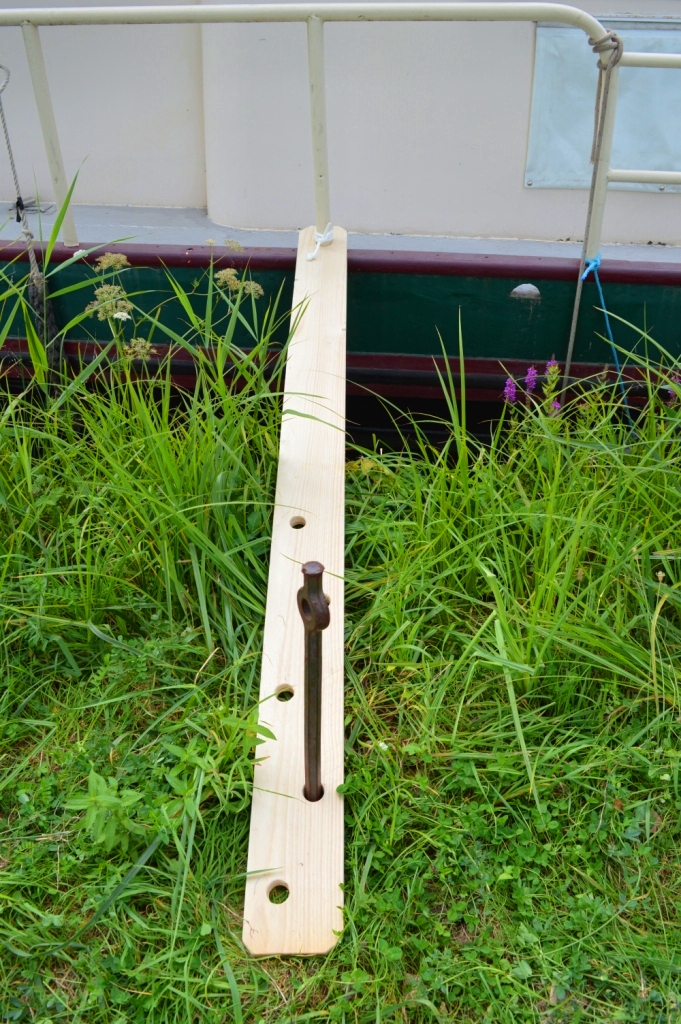
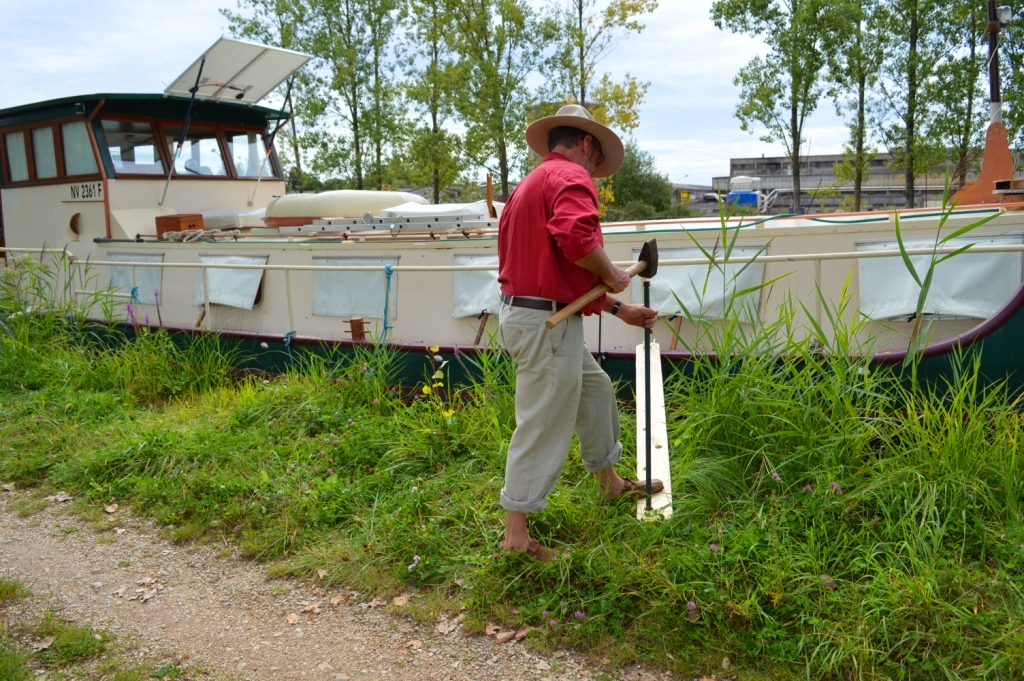
He cycled back carrying a long plank of cheap-ish wood (there, that shows my knowledge of wood!). I heard the drill and saw, and poked my head out to see these….
From the boat
From the bank
To increase our range of mooring opportunities and protect our expensive underwater paint, Noel came up with this idea. I am sure old hands have done something similar/better already, but I think these are pretty great and wanted to share them with you.
Noel setting up the planks (and our OLD paintwork!)
The different holes give us a different range. Currently we are about one metre away from the bank. Our adopted cat likes them too – they are her personal-boarding platform!
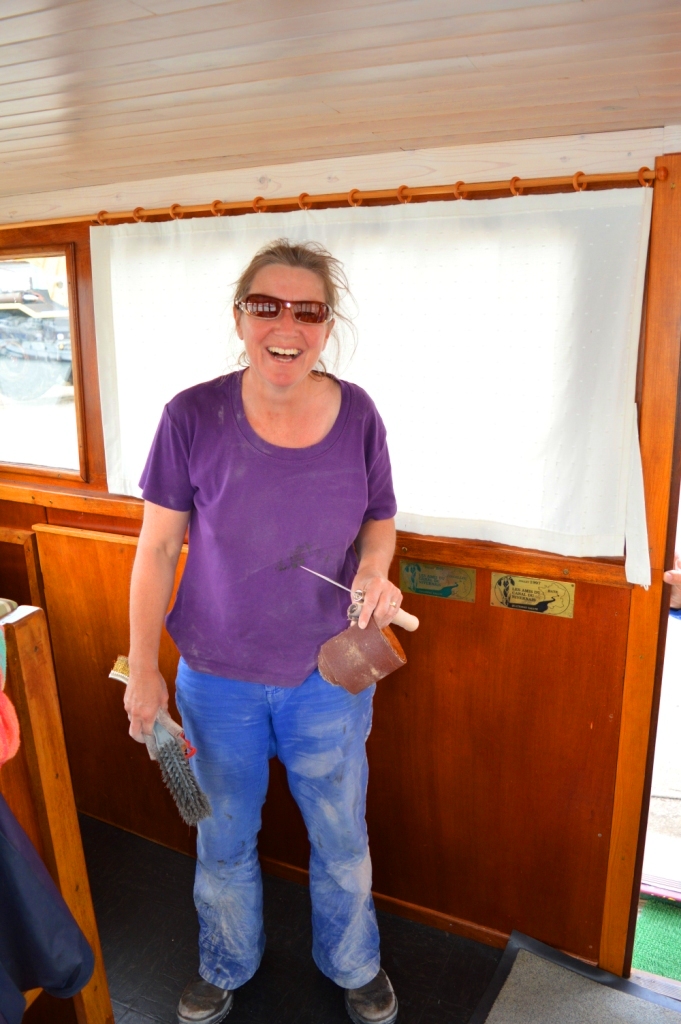
I’ve been reminded about how crappy sanding a boat can be. I must have whinged about the job a fair bit as Noel bought me an electric sander today – and they say romance is dead!
Covered in a layer of sanding dust and looking forward to a beer!
This gift is almost as ‘romantic’ as my first wedding anniversary gift, ‘The 12 Volt Bible’!! But that’s a different, (and a rather incredible), story (more details here).
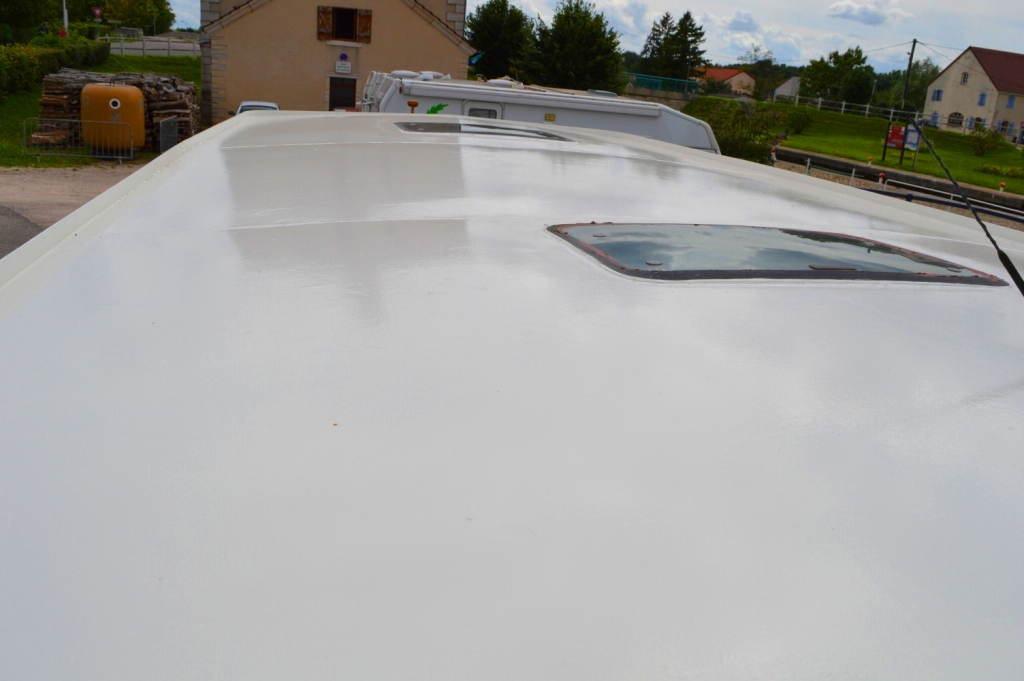
With the pipes clean I turned my attention to the next part, preparing the wheelhouse roof for painting.
First I removed all the loose paint, then I became a sanding maniac. My sore knees, stiff muscles and the fine coating of ‘dust’ reminded me how much I hate sanding.
Lying down on the job – I was just glad I didn’t fall off!
But a good painting job is all about the preparation and after one full afternoon and a full morning – hurrah! I could finally paint!
To the paint, I added Rustol Owatrol, Antirouille Incolore, the French equivalent of Penetrol, which makes oil-based paint stick and flow better. I added fifty percent to the first coat, ten percent to the second coat. The mixture is very good at covering rusty parts of steel, provided there are there no loose flakes.
The first (‘scratch’) coat went on well and highlighted all the bits I missed. The dapple pattern from the rain that followed left me a bit peeved! But, the second coat (and final) is now on and I can play plumber next – extending the ‘down-pipes’ to the water tanks.
Before
After
My new sander and I will work on the rest of the boat . . . soon . . . when I recover!
Recovery food! Chocolate mouse, macadamia and vanilla ice-cream and strawberry tart!
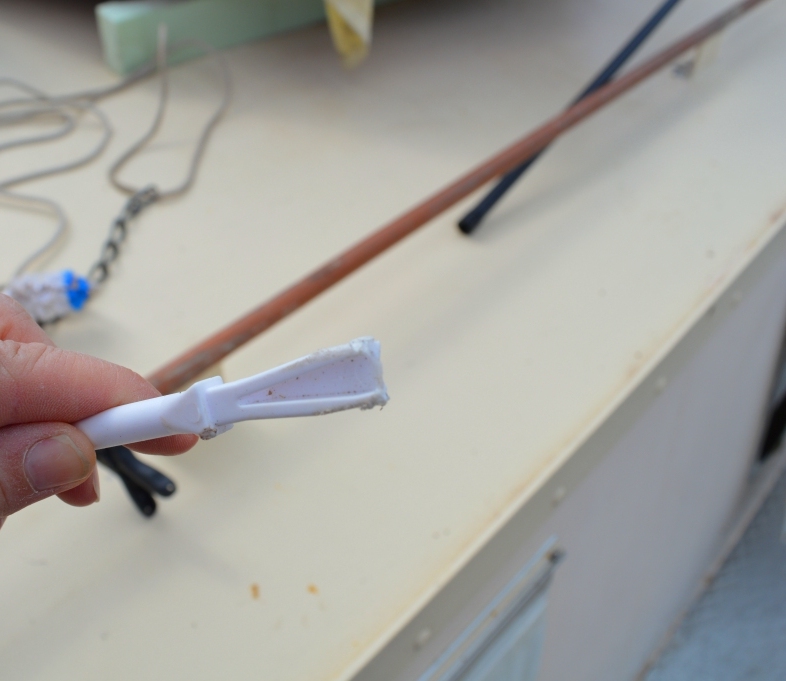
Well the ‘you-beaut-fan-dangled’- cleaning wotsit BROKE! – on its first use! After saying some rather naughty words I sat, and had another drink . . . I mean think.
Where I had ‘made’ the thread, the handle snapped!
I needed:
to get the brush into the pipe
a brush small enough to go around corners
a way to move the brush up and down to clean the inside of the pipe
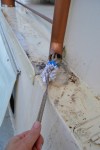
So, I cut the handle off the brush and trimmed the brush down (a new one). Then I drilled a hole through the middle and plaited some string (for strength) and threaded that through the hole. Then, to that string, I tied some strong cord. Ha Ha! That should do it!
Small brush
Until I realised it was impossible to get the cord to thread down the down-pipe. After much uhhming and arrhing – I dismantled the gate-chain on the boat and tied that to the cord. This slinky chain slipped down the pipe dragging the cord with it.
Cord and chain
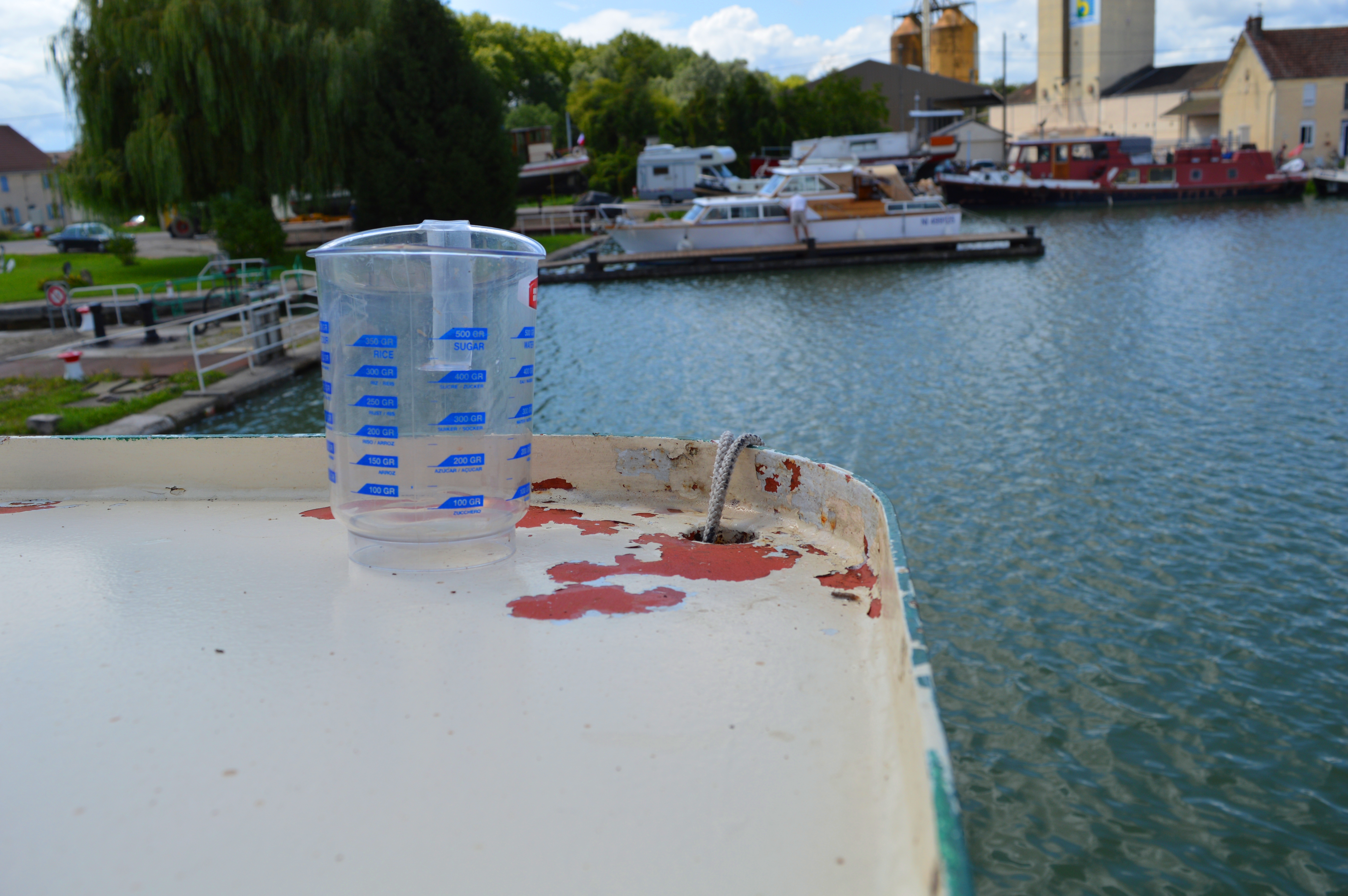
The top of the roof
What followed was a rather awkward tug-of-war on the cord, each end, to clean the pipes, but it worked! Success. Now I have to get sanding and painting!
Only you know your financial situation. It’s time to be honest with yourself!
In the first article we wrote:
1) What budget do I have to purchase a boat? Whatever budget you have it is extremely likely that you will find a boat you love just that ‘bit’ over your budget. This amount does NOT include:a) all the unexpected problems found during survey that need to be fixedb) all the things the vendor neglected to tell you that needed to be fixedc) all those things that just pop up at inopportune times that need to be fixed
d) on-going maintenance and repairs
e) additional equipment (your own ideas/wants)
Summary: Keep at least 10% of your budget for those unexpected issues.
What’s the real question?
The more pertinent question is, what do I get for my money? And, what other factors do I have to consider?
What do I get for my money?
Advice
The best advice is research, research, research. While sailboats vary dramatically in size, layout, design and price, after some in-depth researching you will create a feel for the value presented. Sorry to harp on, but it is all about research. And to only consider the boat purchase cost on its own is foolhardy.
Learn
Researching will expand your know-how. Ask questions, seek advice, you will be amazed how your knowledge grows. We spent two years searching for our second boat, all via internet (we wanted to buy a boat in America to experience the Pacific Ocean for a second time).
$0 – millions
You can spend millions or a few thousand. Actually, a few hundred if you are willing to put in the time/money to make is seaworthy. But then you have to consider whether you want to GO cruising now or WORK for several years on a boat first.
Other considerations
As mentioned previously, it is not just the initial purchase, boats have to be maintained constantly. The marine environment is extremely harsh. Without proper care your boat can quickly become un-seaworthy. The problems will spiral out of control – causing the costs to escalate out of control. Everything that moves wears out and will need replacing eventually, this includes sails. As a guide, everything that moves lasts about ten years, motor, winch, sails etc, then it will need an overhaul or replacing.
Costs to keep in mind: see here for full article on calculating your costs. Your on-going expenditure will depend on:
From what point you started, ie condition of boat
Equipment on board
A smaller, seaworthy, good condition boat is far better than a large, poorly maintained, vessel that will just become a money pit!
Size matters.
Size matters
The size of the boat will matter. We reckon about ten feet per decade. So:
If you are ten years old, you want a sailing dinghy of ten feet.
In your twenties you can get by on a twenty-seven footer.
When you reach thirty you may want a bit more comfort and so on.
It’s almost like a foot for every year of your life (up to about fifty). However, larger boats can be more expensive (longer length means a longer bill at marina), you may need more gear (longer rigging, larger sails). That said, you can make savings with a bigger boat by stowing more spare parts and stocking up at cheap locations.
Fibreglass/Timber/Steel/Aluminium/Ferro
Boat material will be a factor. Which material do you like working with best? That may make you a saving if you can work on it rather than employing someone else to do the work.
Our priorities when buying a boat
Watertight integrity
Seaworthiness
Material/keel setup
Heavy displacement (for crossing oceans)/handling capabilities
Equipment (is it all working? Can you maintain it?)
Age/condition
Can we accept, repair, replace, are familiar with all the things that are not perfect.
When we bought Pyewacket, we had to install solar panels and wind generators.
The Answer
The answer as per cost is dependent on:
Where you are buying (USA, Caribbean, UK, Australia, Europe . . .)
Condition of boat
What equipment does it comes with?
What skills do you have?
What is your budget (allowing for additional unseen/planned costs and running costs)?
The key to cruising is feet. It is -really, or something similar – like hair or legs or . . .let me explain.
Love the boat you have, is one of the snippets of advice we provide in our book Cruisers’ AA. This was a tip we received from a down-to-earth, long-term cruiser.
Love the boat you have. (Mariah II)
What does this mean? Well, maybe you have a dream you aspire to – a bigger boat, a better boat, or a boat with more equipment. Well, you can wish for all this . . . but still, love the boat you have.
Maybe that won’t make sense until you are cruising. For us it means that you put whatever resources you have into the boat you have, with love, with care, with effort and respect. Then that boat will pay you back, it will love and care for you and it will even respect you.
Feet? So what the blazes has feet got to do with it?
I hate my feet. Well, I did up until about two weeks ago. You see, I have rather wide, and in my opinion, ugly feet (for one reason or another, let’s just say they aren’t the prettiest of feet).
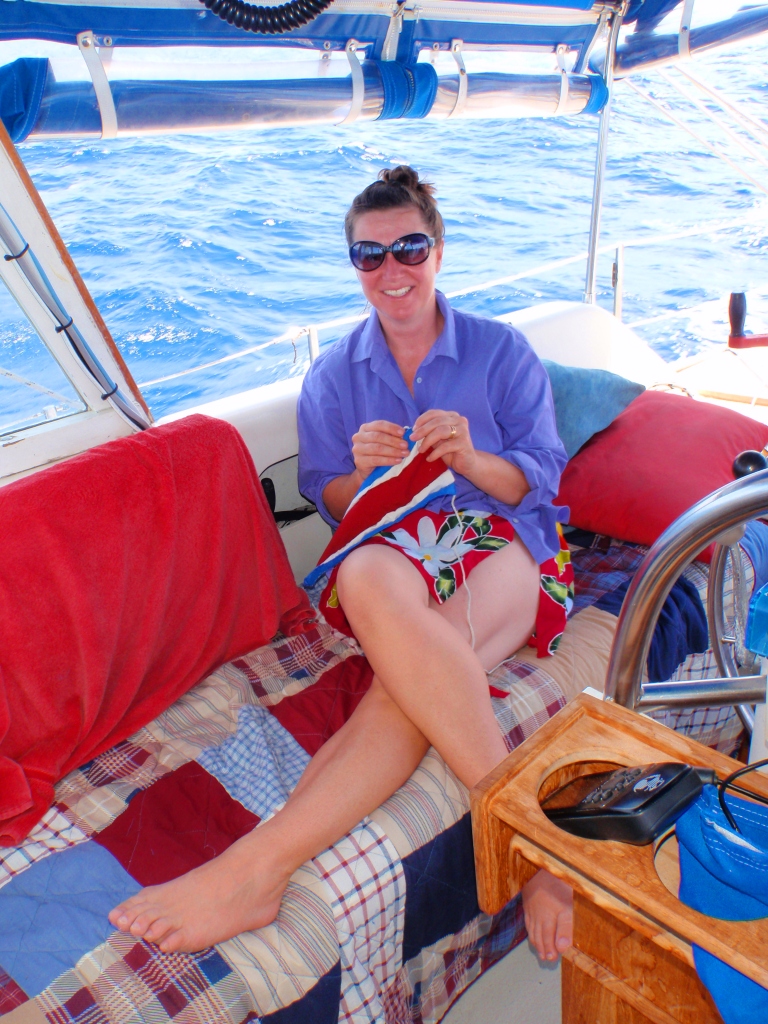
Sailing the Pacific Ocean on Pyewacket. Making courtesy flags & resting my feet!
For the last few weeks I’ve been really caring for my feet, exfoliating, moisturising, and buying and wearing nice shoes that hide the ‘not so nice bits’.
Tonight, as I rest my naked feet up on the settee they feel nice, they’re healthy, and they don’t look half bad. And that is what we mean by love the boat you have. Love what you have.
I take care and love my feet and now they feel great, so I feel great. They may take care of me for longer than they would have, had I not cared for them. Now I quite like my feet – actually, I’m quite attached to them!
Whatever you are dealt with, in either body parts or possessions – love what you have. Make of it what you will, and it will make you.
Anyone would think we were planning an ocean voyage. While we had use of a car for an extra day, we stocked up with bulky/heavy shopping for the boat. You know the kind of things, items that won’t go off in the near future.
Yesterday’s shopping
I re-arranged the galley, and started to wonder, ‘just how does everyone else pack their gear?’ I tend to keep sauces together, tins together, dried stuff together and potatoes and onions in a cool dark spot (they can last for weeks and weeks).
More food means more ideas and yummy dinners!
I am quite the ‘stower’ on board. On Mariah (our first boat which was a 33 ft sail boat), we’d fill the floor with bags of food, prior to an ocean crossing. Noel could never understand where I had put it all.
My positive?, the car is expensive but down the line, we will have saved our backs carrying heavy shopping, and I feel a real sense of satisfaction when we are fully ‘stocked up’.
By the by, please remember to always cut the plastic rings (the ones used on cans) – we dispose of our rubbish very carefully. Even if these rings go in a plastic bag then a rubbish bin, we still cut them – just in case . . . . they can be very harmful to wildlife.
We’ve ordered a marine toilet from Italy and solar panels from Germany. We’ve got a Dutch bank account and a Dutch built boat. All instructions, on the boat, are in French.
We’re ordering fuses from Holland, ‘they don’t exist anymore,’ insists the French chandlery.
My Dutch phone keeps texting me in Dutch. I can’t get my French phone to work – I have to back up the Sim first, in order to back up the Sim I have to activate the Sim, in order to activate the Sim I have to back up the Sim.
The French dongle (sounds like a poodle) is working just fine – phew!
Thank goodness for lovely places like Ranchot to calm my befuddled brain. And my lovely family from the UK (mum, dad & Kieran (my nephew)) – to help keep me sane!





















 Jackie Parry - author