I had no idea what Noel was working on when he said, ‘I need to buy some timber.’ Noel loves timber, he picks it up off the side of the road, he rummages in bins for it… we always have a good timber supply on board.
He cycled back carrying a long plank of cheap-ish wood (there, that shows my knowledge of wood!). I heard the drill and saw, and poked my head out to see these….
From the boat
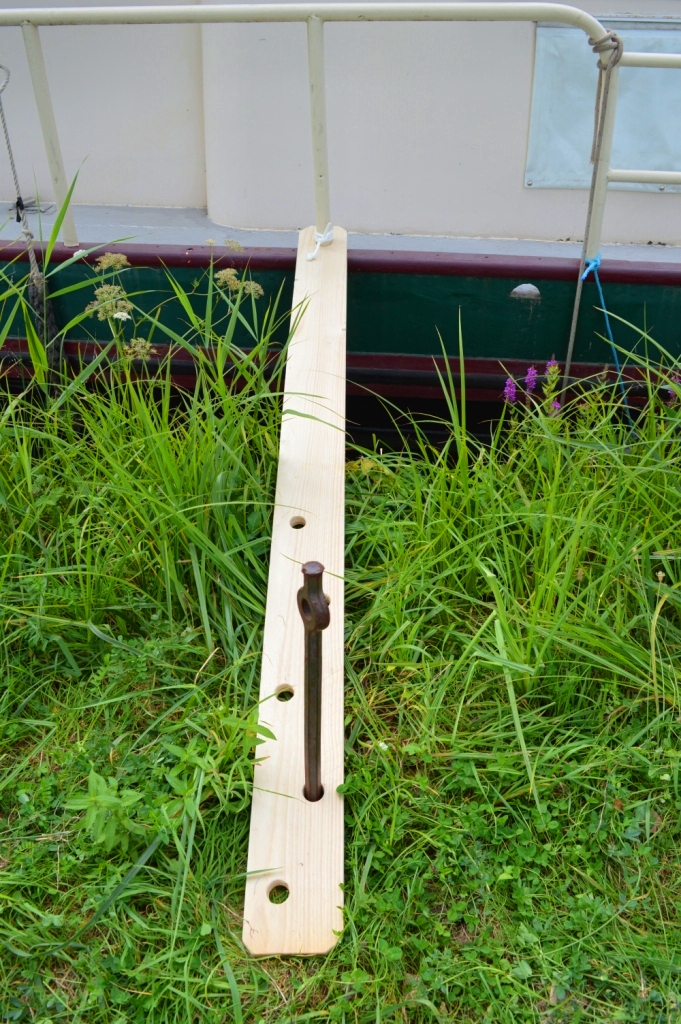
From the bank
To increase our range of mooring opportunities and protect our expensive underwater paint, Noel came up with this idea. I am sure old hands have done something similar/better already, but I think these are pretty great and wanted to share them with you.
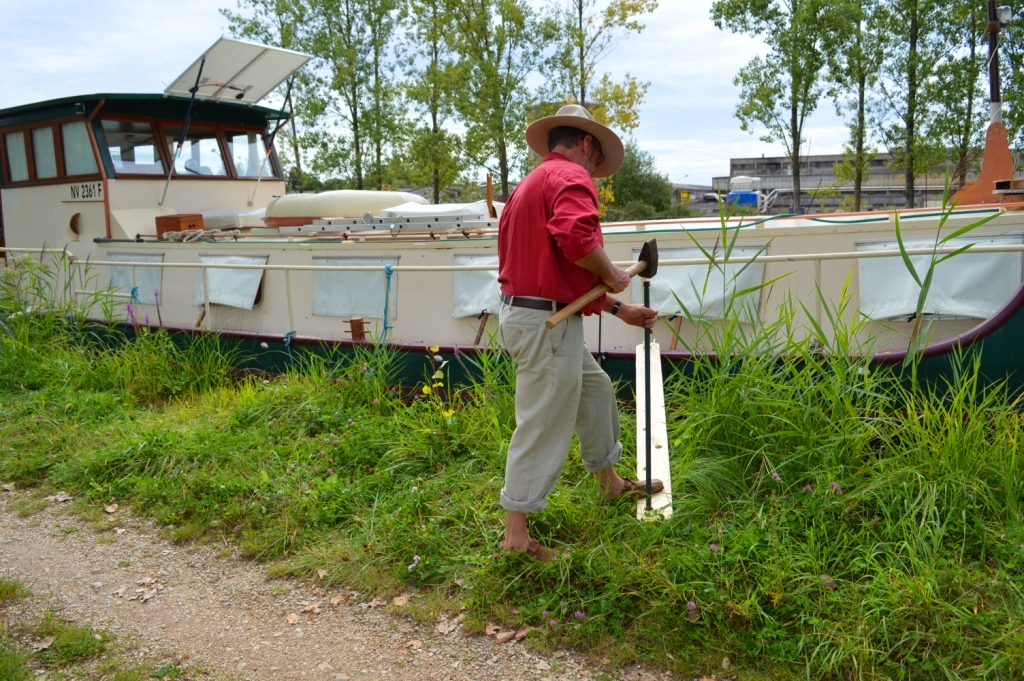
Noel setting up the planks (and our OLD paintwork!)
The different holes give us a different range. Currently we are about one metre away from the bank. Our adopted cat likes them too – they are her personal-boarding platform!
Well the ‘you-beaut-fan-dangled’- cleaning wotsit BROKE! – on its first use! After saying some rather naughty words I sat, and had another drink . . . I mean think.
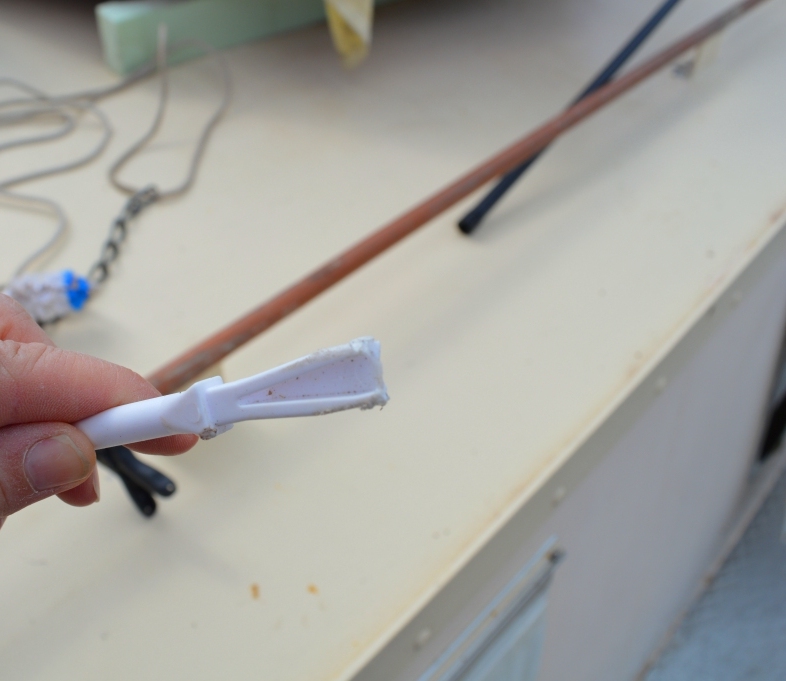
Where I had ‘made’ the thread, the handle snapped!
I needed:
to get the brush into the pipe
a brush small enough to go around corners
a way to move the brush up and down to clean the inside of the pipe
So, I cut the handle off the brush and trimmed the brush down (a new one). Then I drilled a hole through the middle and plaited some string (for strength) and threaded that through the hole. Then, to that string, I tied some strong cord. Ha Ha! That should do it!
Small brush
Until I realised it was impossible to get the cord to thread down the down-pipe. After much uhhming and arrhing – I dismantled the gate-chain on the boat and tied that to the cord. This slinky chain slipped down the pipe dragging the cord with it.
Cord and chain
The top of the roof
What followed was a rather awkward tug-of-war on the cord, each end, to clean the pipes, but it worked! Success. Now I have to get sanding and painting!
Only you know your financial situation. It’s time to be honest with yourself!
In the first article we wrote:
1) What budget do I have to purchase a boat? Whatever budget you have it is extremely likely that you will find a boat you love just that ‘bit’ over your budget. This amount does NOT include:a) all the unexpected problems found during survey that need to be fixedb) all the things the vendor neglected to tell you that needed to be fixedc) all those things that just pop up at inopportune times that need to be fixed
d) on-going maintenance and repairs
e) additional equipment (your own ideas/wants)
Summary: Keep at least 10% of your budget for those unexpected issues.
What’s the real question?
The more pertinent question is, what do I get for my money? And, what other factors do I have to consider?
What do I get for my money?
Advice
The best advice is research, research, research. While sailboats vary dramatically in size, layout, design and price, after some in-depth researching you will create a feel for the value presented. Sorry to harp on, but it is all about research. And to only consider the boat purchase cost on its own is foolhardy.
Learn
Researching will expand your know-how. Ask questions, seek advice, you will be amazed how your knowledge grows. We spent two years searching for our second boat, all via internet (we wanted to buy a boat in America to experience the Pacific Ocean for a second time).
$0 – millions
You can spend millions or a few thousand. Actually, a few hundred if you are willing to put in the time/money to make is seaworthy. But then you have to consider whether you want to GO cruising now or WORK for several years on a boat first.
Other considerations
As mentioned previously, it is not just the initial purchase, boats have to be maintained constantly. The marine environment is extremely harsh. Without proper care your boat can quickly become un-seaworthy. The problems will spiral out of control – causing the costs to escalate out of control. Everything that moves wears out and will need replacing eventually, this includes sails. As a guide, everything that moves lasts about ten years, motor, winch, sails etc, then it will need an overhaul or replacing.
Costs to keep in mind: see here for full article on calculating your costs. Your on-going expenditure will depend on:
From what point you started, ie condition of boat
Equipment on board
A smaller, seaworthy, good condition boat is far better than a large, poorly maintained, vessel that will just become a money pit!
Size matters.
Size matters
The size of the boat will matter. We reckon about ten feet per decade. So:
If you are ten years old, you want a sailing dinghy of ten feet.
In your twenties you can get by on a twenty-seven footer.
When you reach thirty you may want a bit more comfort and so on.
It’s almost like a foot for every year of your life (up to about fifty). However, larger boats can be more expensive (longer length means a longer bill at marina), you may need more gear (longer rigging, larger sails). That said, you can make savings with a bigger boat by stowing more spare parts and stocking up at cheap locations.
Fibreglass/Timber/Steel/Aluminium/Ferro
Boat material will be a factor. Which material do you like working with best? That may make you a saving if you can work on it rather than employing someone else to do the work.
Our priorities when buying a boat
Watertight integrity
Seaworthiness
Material/keel setup
Heavy displacement (for crossing oceans)/handling capabilities
Equipment (is it all working? Can you maintain it?)
Age/condition
Can we accept, repair, replace, are familiar with all the things that are not perfect.
When we bought Pyewacket, we had to install solar panels and wind generators.
The Answer
The answer as per cost is dependent on:
Where you are buying (USA, Caribbean, UK, Australia, Europe . . .)
Condition of boat
What equipment does it comes with?
What skills do you have?
What is your budget (allowing for additional unseen/planned costs and running costs)?
The key to cruising is feet. It is -really, or something similar – like hair or legs or . . .let me explain.
Love the boat you have, is one of the snippets of advice we provide in our book Cruisers’ AA. This was a tip we received from a down-to-earth, long-term cruiser.
Love the boat you have. (Mariah II)
What does this mean? Well, maybe you have a dream you aspire to – a bigger boat, a better boat, or a boat with more equipment. Well, you can wish for all this . . . but still, love the boat you have.
Maybe that won’t make sense until you are cruising. For us it means that you put whatever resources you have into the boat you have, with love, with care, with effort and respect. Then that boat will pay you back, it will love and care for you and it will even respect you.
Feet? So what the blazes has feet got to do with it?
I hate my feet. Well, I did up until about two weeks ago. You see, I have rather wide, and in my opinion, ugly feet (for one reason or another, let’s just say they aren’t the prettiest of feet).
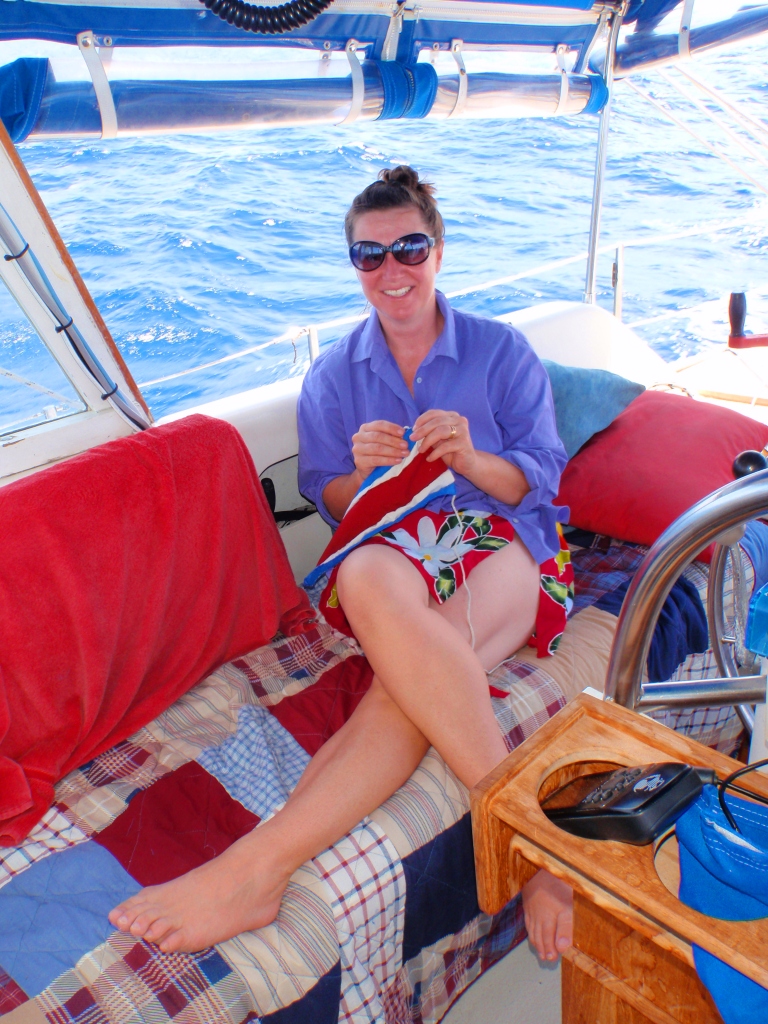
Sailing the Pacific Ocean on Pyewacket. Making courtesy flags & resting my feet!
For the last few weeks I’ve been really caring for my feet, exfoliating, moisturising, and buying and wearing nice shoes that hide the ‘not so nice bits’.
Tonight, as I rest my naked feet up on the settee they feel nice, they’re healthy, and they don’t look half bad. And that is what we mean by love the boat you have. Love what you have.
I take care and love my feet and now they feel great, so I feel great. They may take care of me for longer than they would have, had I not cared for them. Now I quite like my feet – actually, I’m quite attached to them!
Whatever you are dealt with, in either body parts or possessions – love what you have. Make of it what you will, and it will make you.
This was my second question to Noel when we were searching for our first boat – (see the first question here).
At this point I hardly knew the front end of a boat from the back end. I also found the cruising world completely mind-boggling.
Noel’s response to this question, ‘getting to port’, holds a lot of truth (for us). I love being out there but with only two of us on board, after several days of a tag-team match (one is always on watch) it does become tiring. The constant demand on your body to move three-dimensionally, twenty-four hours a day, causes fatigue (the reason most accidents occur). Plus we are always looking forward to exploring our next destination.
What’s it like?
Sailing oceans is not like a plane or car ride. Nothing is certain except a vast puddle of water and a great stretch of sky…
This was advice from a long-term cruiser and a friend.
I had to stop and think about this for a bit. I knew, with just five small words, she’d said something remarkable.
Don’t sweat the small stuff.
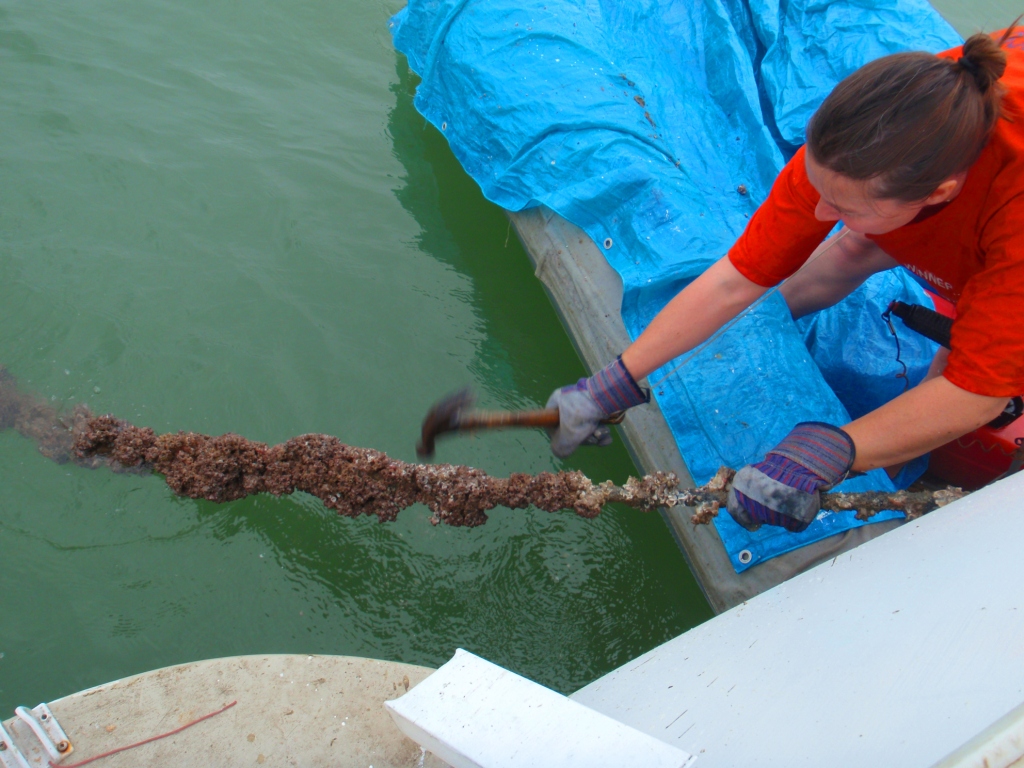
Months of hard growth on the lines – days of cleaning . . . is it worth worrying about?
What is the small stuff on board?
The laundry (in cold water, by hand)
The blocked loo (marine toilets are renowned for this delightful occurrence)
The entire boat turning into a workshop
Running out of gas in the middle of cooking
Salt saturated cushions that just won’t dry
A lumpy sea
Too much wind
Big waves
Cleaning behind the cooker – is it worth getting worked up about it?
So when do you ‘sweat’? Well usually you don’t, usually there’s no time.
Maybe you’d sweat during a storm, which can last for days. But, generally ‘sticky’ moments on board are in bursts:
fingers of lightning
winds shifting to create an untenable anchorage
dragging anchor
broken rudder . . .
. . . these are moments when you may sweat . . . IF YOU HAVE TIME.
Instead of sweating you’ll be too busy doing what’s necessary.
The great thing is, those moments where you don’t have time to sweat are great training for when it really matters.
Rough seas – do what’s necessary to make the boat safe, then relax
Yes, cruising can have its shitty moments, it can be scary, but each challenging moment will build your confidence and faith in your boat and yourself – creating comfort and a more relaxed life that just keeps on improving.
Tomorrow is the next instalment on our CRUISING CLINIC – What’s so great about cruising?
When Noel and I decided to go cruising, as a complete beginner I had two very pertinent questions on my mind. I asked these questions as we hopped on the back of Noel’s motorbike, searching for a boat.
‘So, what’s it going to cost, running a boat?’
He replied, ‘Everything we’ve got.’
A little perplexed, but not yet deterred, I then asked, ‘What’s so great about sailing anyway?’
Noel, with his brutal honesty and years of experience with boats replied, ‘Getting in to port.’
‘Good grief’, I muttered. After about two hours of silence while I digested these little gems, I said, ‘Why do it then?’
Without hesitation Noel responded, ‘It’s the closest thing to freedom I know.’
That did it for me. It was right then that I was sold on the idea. Sixteen years later I still see the wisdom in his answers.
What’s so great about sailing . . .?
I’ll write about the ‘what’s so good about sailing?’ question down the line. Right now, I guess you’re thinking, ‘well so what?, that doesn’t help me very much.’ However, think about this: cruising WILL cost you everything you have, if you let it.
So, let’s look at the right questions to ask to see if we can make sense of all this:
1) What budget do I have to purchase a boat?
2) What will it cost to run?
3) How will I earn money along the way?
4) How can I save money along the way?
Boats can be as expensive or as cheap as you make them. We find that living on board is a cheaper way to live, but we know how to save money, I am extremely prudent with our dollars and we employ smart tactics. AND you have to start with a good boat, then maintain it – constantly (a job a day, however big or small).
We were still trying to figure out where to stow everything!
Now, let’s try and find some answers.
1) What budget do I have to purchase a boat? Whatever budget you have it is extremely likely that you will find a boat you love for a ‘bit’ more and go over your budget. This amount does NOT include:
a) all the unexpected problems found during survey that need to be fixed
b) all the things the vendor neglected to tell you that needed to be fixed
c) all those things that just pop up at inopportune times that need to be fixed
d) on-going maintenance and repairs
e) additional equipment (your own ideas/wants)
Summary: Keep at least 10% of your budget for those unexpected issues.
A job a day kept Mariah ship-shape.
2) What will it cost to run? It depends on where you started from. If you are really lucky and have a good, well maintained boat, then it will also depend upon:
a) the size of your boat*
b) amount of use (little use is not always a good thing)
c) your skills (can you maintain it and carry out repairs? Or do you need help?)
3) How will I earn money along the way? Be creative. Use the skills you have. Other cruisers need expertise in all areas. We’ll tackle this subject later on too. However, running your own business is not easy on land, don’t expect it to be easy while cruising. You have the added challenge of communications.
4) How can I save money along the way? This is the easy bit – if you are prepared to change your lifestyle.
Stop spending it! Really. Don’t eat out all the time, figure out how to fix stuff yourself. Learn how to get the best bargains on boat equipment, learn how to keep food for weeks and weeks (without a fridge if necessary, we did for nine years), anchor out and avoid mariner fees. I could go on and on, and I did in our book Cruisers’ AA (accumulated acumen). I’ll supply more tips down the line, on each of these subjects.
If this all sounds off putting, well you’ve given up too soon. Cruising life is fantastic, but it is not for everyone. If you like a challenge, can adapt to new situations and want to enjoy your life in a way you never dreamed of – then maybe it is for you.
A good boat to start with & on-going maintenance will ensure you get to all those places you dreamed of.
I’ll write more on all these subjects (1-4) in the coming weeks. Cruisers’ AA (accumulated acumen) covers all this and much more in far greater detail, see www.jackieparry.com for more information – available in paperback & ebook). (Or look at the top of this page and follow the links!)
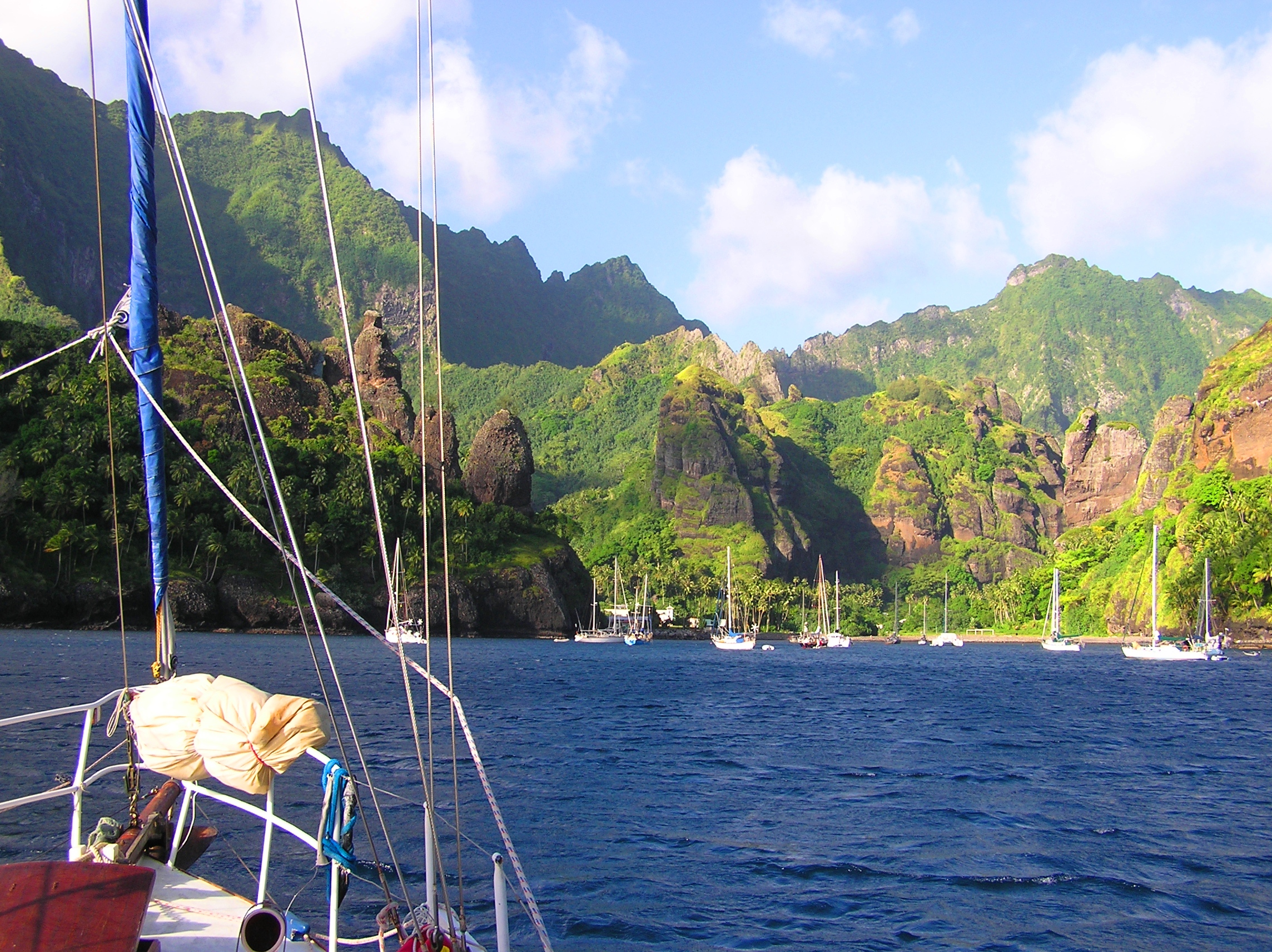
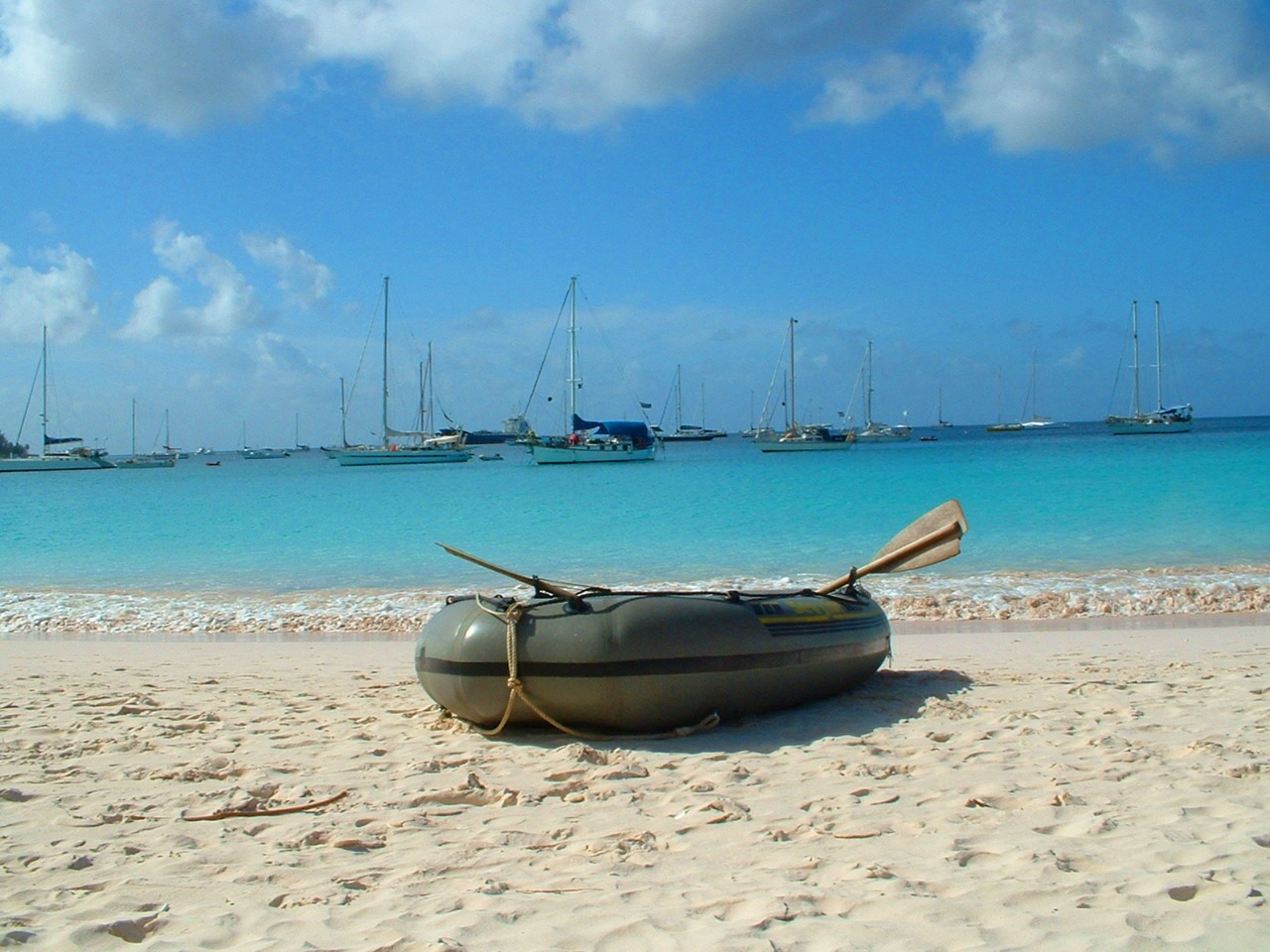
You can sail to the most wonderful places & experience new escapades!

















 Jackie Parry - author