Jackie Parry – author


2 Comments

Navigation: great links and me!

I love navigating, whether by stars, chart or GPS. Usually, on a voyage we navigate via GPS but back-up this wonderful device with good old chart work. On occasion we do sun-sights too.

Here are many diagrams on good navigation skills. Both recreationally and commercially, Noel and I have used every single one of these methods.

For example:

Parallel indexing in fog

range rings single pics

DR when the GPS has lost its signal (or as back-up)
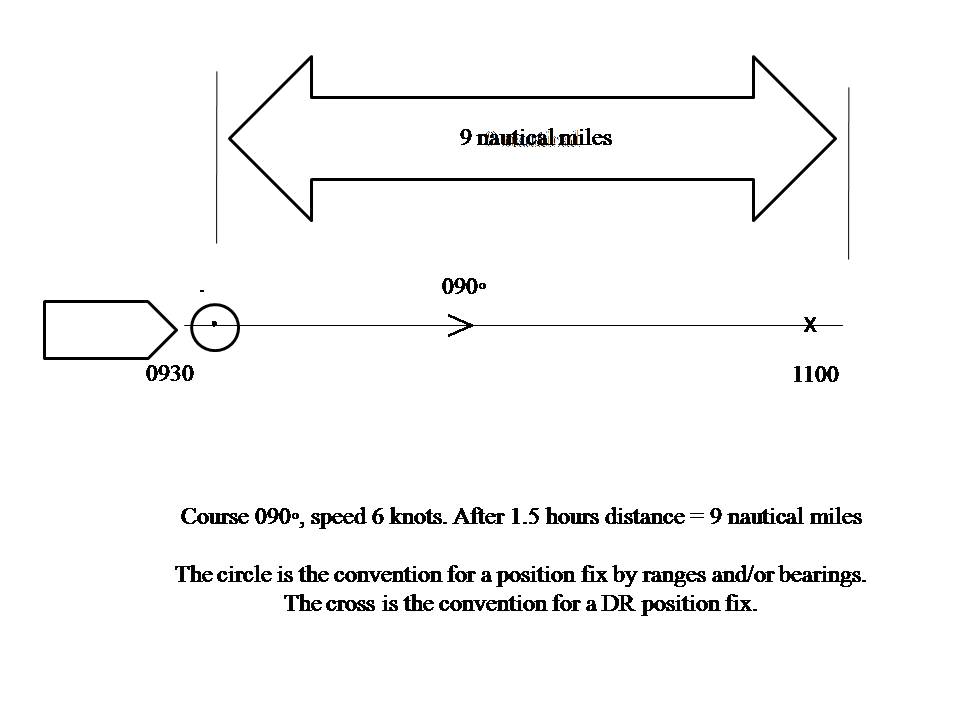
9 nautical miles (DR)

Set and drift when heading to GPS co-ordinates, on an urgent rescue

course to steer (finding) single pic

Always learning

A few years ago I was a skipper on different ships in Papua New Guinea (Noel had his own-different-ship), with thirteen local men as crew. The charts were out of date, there were chart errors* and GPS errors. I HAD to rely on my navigation skills. This wasn’t easy, I was in new ports, fast currents, narrow channels and a boat with its controls labelled in Japanese (plus 300 passengers).

Coupled with all this fun, some of the boats were air-started… use too many forward and astern manoeuvres when docking (on a busy commercial wharf), and you run out of air, run out of….. engine!

SAMSUNG DIGITAL CAMERA

My skills
I was told today that I don’t have enough skills to be a trainer – which is my job in Australia. Assumptions were made after reading my blog. So I’m giving myself a shout-out today.

Proud
I am proud of my skills, they have been earned. I’ve not only been a commercial skipper on the high-seas, but busy inland waterways and canals too. As a commercial skipper (up to 80 metres) I have had, not only, to sit tough exams (written and verbal and practical), to gain my tickets, I have to prove my commercial sea-time and prove my skills and experience by signed reports by Captains of a higher level. My qualifications were only granted after the assessments were done and, in some cases, years of sea-time had to documented.

So, yes, this is a shout out for me! …and…

By the by, combining Noel’s experience with mine, both recreational and commercial, into a book isn’t easy (it’s a big book) – but it is amazing value at $4.99! – more pictures here and here. Plus another great resource here.

9780987551504 - Copyreduced

  • Cruisers’ AA contains details on all the errors that can occur, and how to deal with them – some may well surprise you!

16 Comments

Eating Healthy for your body and wallet

My body has been hinting, quite heavily, at the kinds of food I should and should not be eating. I’ve decided to try and listen to what my tummy is telling me and eat less meat; certainly less red meat.

I have always wanted to adopt a healthier way of living and have managed to find excuses. Now, when I seem to be busier than ever, I’ve delved into cooking vegetarian (mostly) meals and I am amazed at the fantastic results.

So, after finding the wonderful farm/vegetable shop four kilometres up the road, I rubbed my hands together, googled vegetarian recipes and off I went – here’s the first week. (I spent 20 Euros on three huge bags of vegetables.)

Just a small part of my first shop.

Just a small part of my first shop.

First night: Ginger Veggie Stir Fry

I used the vegetables I had purchased that day and I used plain old flour instead of cornstarch. I never have all the correct ingredients. This worked a treat.

I cook great rice, even if I say so myself. I cover the rice by about an inch of water (maybe a fraction less), boil until the water goes milky, then put the lid on and turn off the heat. Ten to fifteen minutes later, perfect rice.

This meal fed Noel and I for two nights.

Stir-fry

Stir-fry

Second night: Left over Ginger Veggie Stir Fry.

Third night: Curried Lentil Pies Recipe

This is a fantastic recipe, so easy and so fulfilling.

I stirred in some Tandoori paste instead of ghee. I used olive oil instead of butter, I didn’t use mustard seeds or ground cumin and I used the vegetables I had purchased. Definitely use pumpkin and potato for the top – fabulous!
This fed us for three nights! And I have made it again since, I can’t get enough of this and it fills me up easily.

Curried Lentil Pie

Curried Lentil Pie – when dished out, add a spoon-full of natural yoghurt – delicious

Fourth & Fifth nights: Left over curried pie.

Sixth night: Chicken stew

Noel bought some chicken. I find it hard to completely cut meat out of our diet. I enjoy it, but I haven’t eaten red meat for a few months now and I certainly feel the benefits.

This was just plain old chicken stew, with all those great ‘in season’ veges, swedes, parsnips, carrots, also onions, leeks, and whatever you have to hand.

I braised the chicken separately first. In the big pot I used vege stock, cup of wine, a few herbs (whatever is to hand – basil, parsley), a bit of sweet chilli and soy sauce. A half a cup of French lentils is a good idea to help fill you up. Perfect!

So easy, tasty and filling.

So easy, tasty and filling.

Seventh & eighth night: Left over chicken stew

Healthy wallet

My 20 Euro shop lasted a week-and-a-half (and I still have a whole cabbage left). I did another shop this week, and that cost 13 Euros – for two enormous bags of veges. This week I tackled:

Spinach and blue cheese frittata – I didn’t have nuts or tomatoes, it was still yummy.

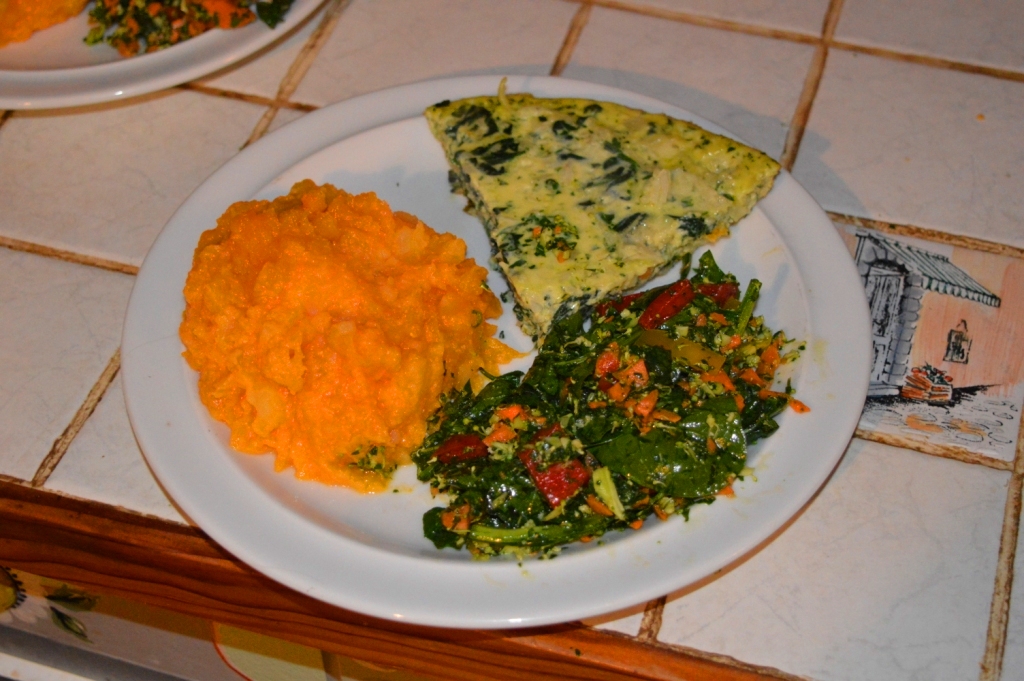
We'd worked hard that day - so I added pumpkin and potato mash and a delicious salad of spinnach, fresh parsley, carrot, zuchinni, onion - yum!

We’d worked hard that day – so I added pumpkin and potato mash and a delicious salad of spinnach, fresh parsley, carrot, zuchinni, peppers, onion – yum!

A treat! – Walnut and Coffee Cake

We were given some walnuts and did I have fun cracking them – then I made this wonderful, truly fantastic cake – with a healthy twist!

I didn’t want to use double cream and I had only ‘normal’ yoghurt. So I spooned out two pots of yoghurt (small pots) into coffee filters (one pot per filter), then, I stood the filters in a colander, and let all the liquid drain away. Voila! Thick (Greek style) yoghurt – thick enough to use as a cream substitute!

Draining the yoghurt - for 1-2 hours.

Draining the yoghurt – for 1-2 hours.

It worked perfecting – the icing is so sweet that the yoghurt balances out the sweetness and in all honestly, tasted just like cream!

Not as pretty as the recipe picture - but absolutely delicious!

Not as pretty as the recipe picture – but absolutely delicious!

I was so proud of my efforts - I had to include two pics!

I was so proud of my efforts – I had to include two pics!

Healthy living

I am loving the ‘zone-out’ time cooking is giving me. My body is enjoying the benefits and so is our bank balance! The big plus is finding recipes that are fulfilling, I am a big eater. Now, I can eat as much as I want and I’m not piling on the pounds!

I;d love to hear from anyone who has great recipes to share.


2 Comments

Lightning At Sea Tips – Precautions

It’s one of my biggest fears at sea…. streaks of electricity aiming for the highest thing in the ocean – our mast!

Here’s some tips to help prevent damage and other precautions to take:

Your *oven (or microwave) is a good temporary *‘Faraday cage’ for protecting equipment during a lightning storm. (Faraday cages shield their contents from static electric fields.) During a lightning storm ensure you disconnect your equipment, flicking off a circuit breaker is not enough if you are hit. If you have put your equipment in the oven, don’t forget to remove it before next using the oven or microwave!

In a serious electrical storm, the following is recommended:

Stay below decks (bear in mind to keep a good watch if at sea; the regulations state that ‘Every vessel shall at all times maintain a proper lookout by sight and hearing as well as by all available means appropriate in the prevailing circumstances and conditions so as to make a full appraisal of the situation and of the risk of collision’).
Stay away from the mast, boom, shrouds, chainplates, the mast compression post and mast below decks.
Plot your position and turn off all your electronic equipment.
Be aware of the set and drift so you can do a DR (deduced reckoning) if you have to. (See Navigation section.)
Do not operate radios unless in an extreme emergency.
Lightning storms are usually short lived.

ID-100130887

Image courtesy of foto76 at FreeDigitalPhotos.net

If you suffer a strike:

Check your through-hulls (if they are metal) for any discoloration in the fibreglass or other signs of damage associated with the strike.
Check for electrical damage and check your rigging. Double check your compass, it may have been affected.
Protection: There are lightning protection devices which some people like and others do not. Research your circumstances and see what suits your situation and set up best.

Indirect hit: A lot of damage can be suffered from an indirect hit; a nearby boat or buoy could be hit and the charge can transfer through the water to other vessels.

No GPS or Radio: It will pay to be able to navigate by chart and deduced reckoning; you may have no electronics and no way to radio for help.

Insurance: If you are insured, after a lightning strike call your insurance company at the first opportunity and follow instructions. It will probably mean a haul out and/or inspection.

Excerpt from Cruisers’ AA – now available for around $3.99 (US) on Kindle!

*A Faraday cage is a metallic enclosure that prevents the entry or escape of an electromagnetic field.

*The oven needs to be the type without glass (ie all metal, so a metal door). Please note, this is advice we have taken, and have no actual ‘proof’ it works! – It certainly made us feel better during a lightning storm.


5 Comments

Top tips on weather – how to read a synoptic chart

This week a ‘soon-to-be-cruiser’ asked Noel and I to recommend useful courses to study before starting to cruise. The person in question was already signed up for Coastal Navigation and Deckhands (with all that great safety stuff).

The learning is endless, but immediately we thought of weather. (Also a radio license is a good idea too).

Knowing weather is a trade, there’s a lot to it. Meteorological headquarters all over the world confer daily to create forecasts. But knowing how to read the basics of a synoptic chart, is important.

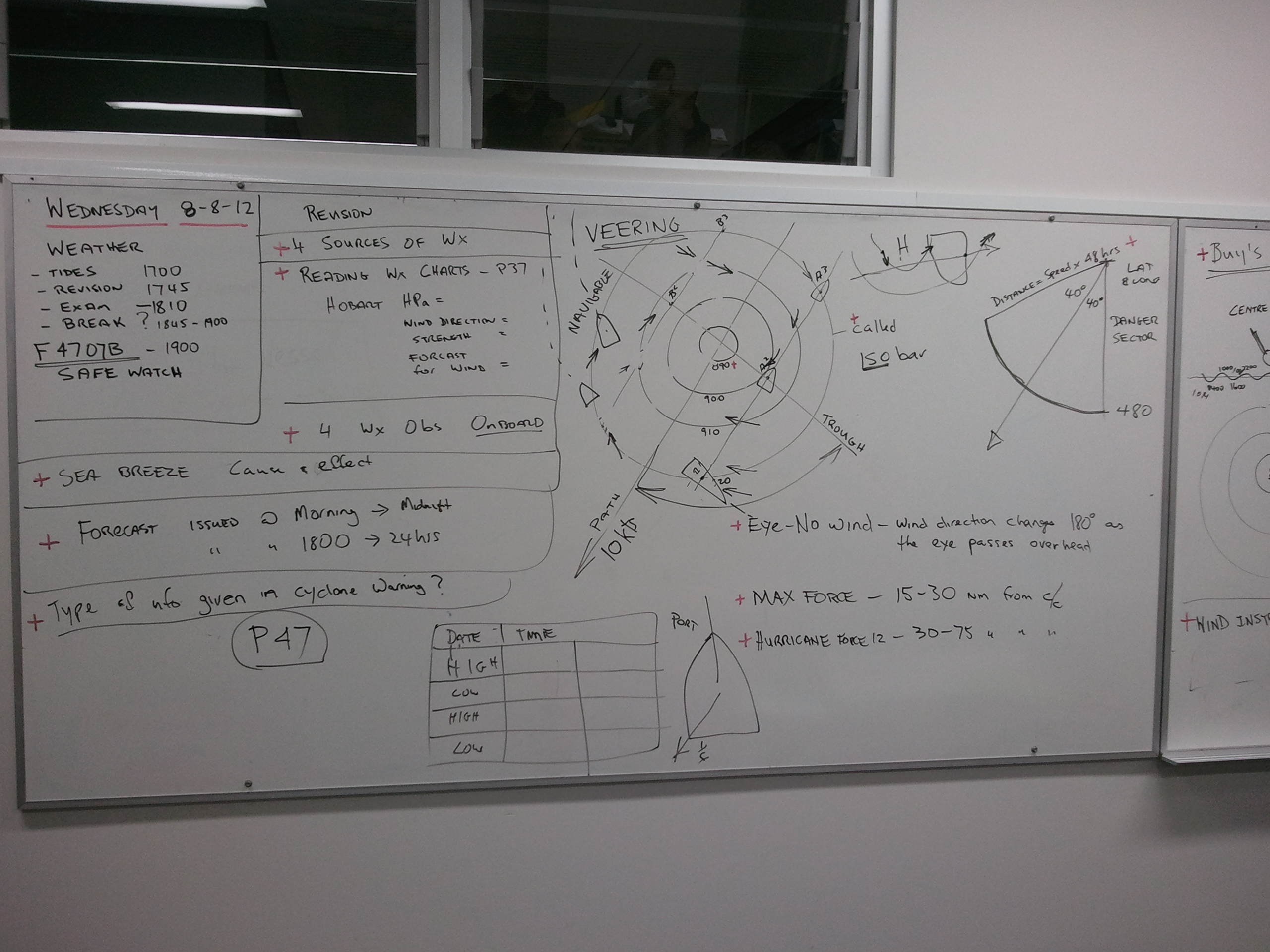
Noel teaching commercial maritime - weather came into most subjects.

Noel teaching commercial maritime – weather came into most subjects.

There are many ways to download weather. Many people rely on internet these days, and you really notice that when trying to find a free station on the SSB (long range radio) to talk on!

We used weatherfax and downloaded the really neat program from JVComm – thereafter all you need is a connection from your radio to your laptop. Every day, we could download, 12, 24, 48 and 36 hour forecasts, both wind/wave and synoptic charts.

The synoptic charts cover a large area and that’s the key. You can SEE what is happening, and what will affect you, and how. You can forecast.

synoptic chart

Here’s a brief break-down of this synoptic chart:
Remember that all systems move from west to east.
Isobars close together, is a steep pressure gradient with corresponding increase in wind strength. Top left, is a good example of isobars becoming compressed between the low in northern Japan and the high in the Atlantic.
A cold front indicated by pointed triangles, indicating the direction of movement. The red semi- circles indicate a warm front. With a front you get a rapid change from low to high pressure.
The mix of triangles and semi-circles is an occluded front.
High pressure ridges and low pressure troughs are usually indications of unsettled weather – possibly squalls and precipitation.
Sharp turns or bumps in isobars generally indicate disturbed weather. Usually something unpleasant!
The two highs at the top will eventually join together, once the cold front has passed. This will create the usual alternate Highs, then Lows.
You can see the doldrums along the equator – no isobars!
Widely spaced isobars indicate light variable winds.
Zig-zag lines are a high pressure ridge – usually containing squalls.
Dashed lines are a low pressure trough – usually indicating rain and wind

Weatherfax frequencies are available worldwide – here’s the list.

Hints and Tips
• Become familiar with the Weatherfax process and schedule prior to departure. If you are in a marina, the signal may not work very well due to interference from masts and equipment.
• To utilise Weatherfax all you need is a good SSB radio (HF), a laptop and an earphone connection from the radio to the laptop. Free software for downloading Weatherfax is available on the Internet or here.
• We usually received a wind/wave forecast for 24 and 48 hours, and synoptic charts (isobars and wind strength) for 24, 48 and 72 hours. The wind strength arrows can cover a large area though.

Weather was in most nautical subject, but had its very own subject too.

Weather was in most nautical subject, but had its very own subject too.

Receiving weather via Weatherfax:
• You must deduct 1.9 kHz off the listed frequencies.
• To receive a good Weatherfax is easy, but the atmospherics can cause disturbances. Ensure you have done everything you can to receive a good picture.
• Turn off EVERYTHING:
• the fridge
• wind generators
• solar panels
• inverters
• electronic steering gear (get someone to hand steer for a while or use the wind vane)
• all electrical devices
• solar panels (install a switch that lets you manually turn them off)

Deciphering pictures:

We like the synoptic charts as they show you why the wind is doing what it is doing, and it can show you an escape route. You can clearly see what is coming.
• Download the worldwide frequency list from here.
• Do not forget:
• Subtract 1.9kHz from the given frequency.
• Some of the listed times are not exact and can change.
• Faxes can come a few minutes earlier and often later than the scheduled times.

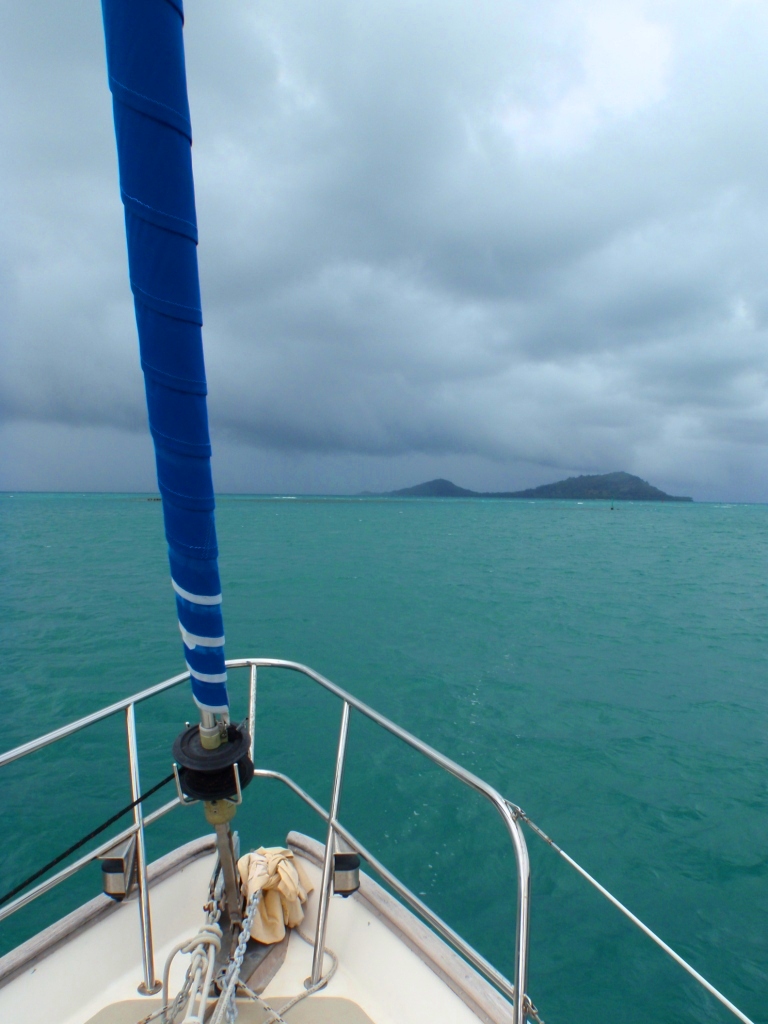
Weather watching at the Gambiers, where a dip in the isobars gave us a good-hiding!

Weather watching at the Gambiers, where a dip in the isobars gave us a good-hiding!

Other boats downloaded weather that was more detailed, but to specific area. It didn’t show the big picture. They could see what would happen today and tomorrow but not long term, whereas we could view a front coming for 5 days, (and we did!) It is amazing to see it on the weather fax then on radar then visually! And then feel its impact!

Wind/wave chart for same area as synoptic chart.

Wind/wave chart for same area as synoptic chart.

Note: That the wind chart stops at 30°N – so you can’t see the gale that is on the synoptic chart!

More Information:
Cruisers’ AA (accumulated acumen) has all this information and much much more. It is now available on Kindle for not much more than a decent cup of copy. (No.5 on the bestseller list! – Amazon)

Of Foreign Build – is also available on Kindle and paperback (and has just become the No. 1 best-seller in its category! – Amazon)

More about us: Noel and I have sailed thousands of ocean miles and have worked internationally on commercial boats – in Australia we taught commercial maritime and all our accumulated knowledge through recreational and professional sea-miles is incorporated into Cruisers’ AA.

Me on a practical assessment for radar and navigation - I always asked students to interpret the weather.

Me on a practical assessment for radar and navigation – I always asked students to interpret the weather.


Leave a comment

ANOTHER GIVEAWAY

Here’s another great giveaway, from fellow author Elizabeth Grace, who’s written a fun book for all the family.

Patches and A Hollywood Tail Giveaway!

Want to win a copy of Patches or A Hollywood Tail? Enter to Win by Providing your Name and Email by clicking here. Accepting Entries until October 31, 2014


6 Comments

An Englishman, Irishman, and Australian were at a market….

We are loving Buzet sur Baise. We’ve perfect autumn weather, a safe and quiet port, nice friends just down the road, all within a wonderful quaint village.

With one week of good weather forecast, Noel and I are busily painting the top sides of Rouge Corsair. It’s so easy to forget how hard painting is, this morning every part of my body aches, including my fingers!

Sunday morning we took a break and cycled 5 kilometres (uphill) to a vide-greniers (garage sale). Although it was more like a huge market with just about everything you could ever want – good stuff too.

Image courtesy of federico stevanin at FreeDigitalPhotos.net

Image courtesy of federico stevanin at FreeDigitalPhotos.net

Within the bustling, friendly market we met, an Australian, an Irishman and an Englishman, who have invited Noel to play cricket, tennis and go cycling. Noel thought this was rather nice, but did wonder, ‘can’t we just sit under the shade of a tree and drink beer?’

Image courtesy of jiggoja at FreeDigitalPhotos.net

Chestnuts! Image courtesy of jiggoja at FreeDigitalPhotos.net

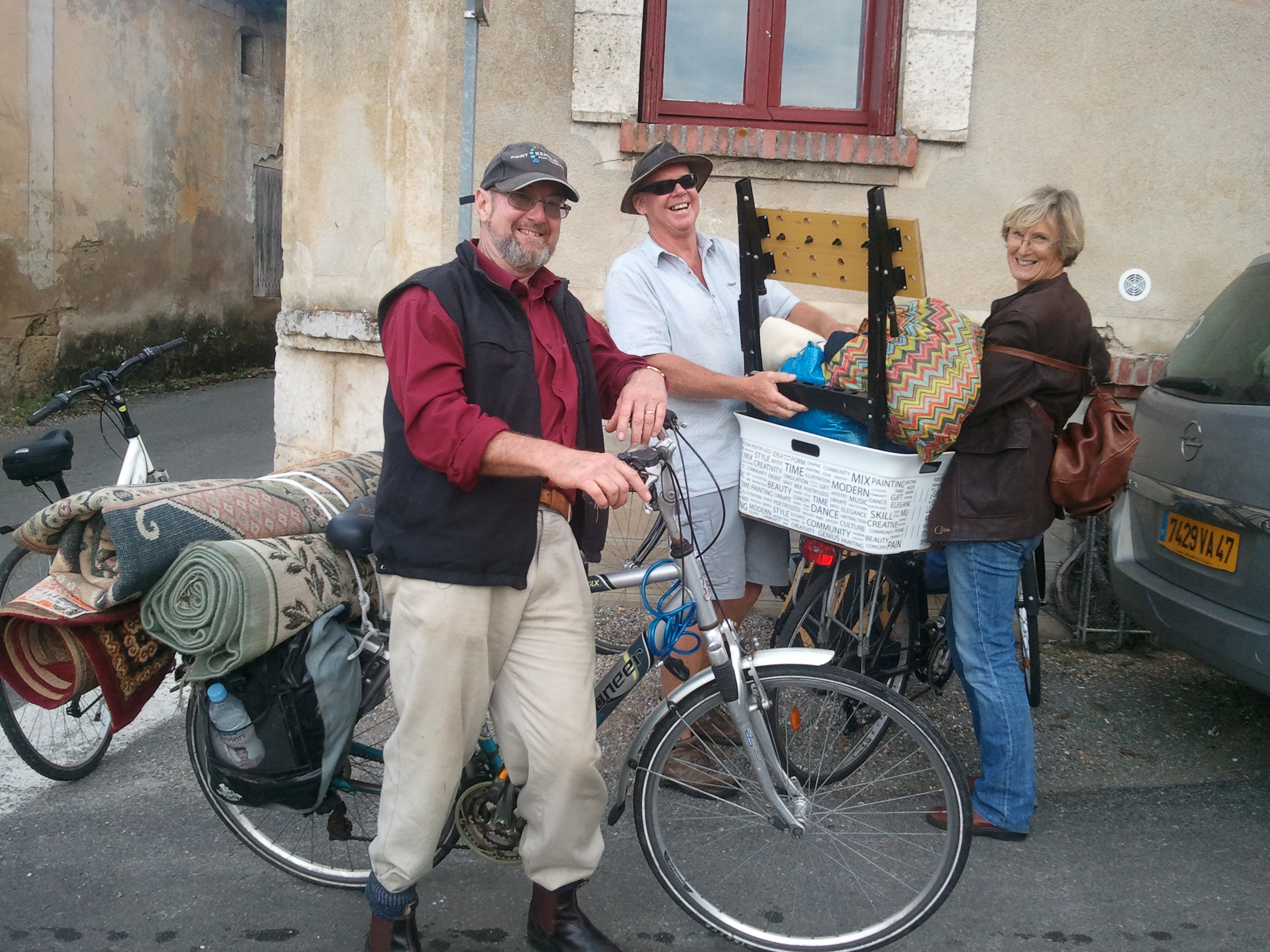
While Noel tried to convince the locals that beer, shade and trees, really was the way to go, I had great fun searching for rugs to insulate our floor for the coming winter, some blankets and bits and pieces. We had great fun with Lorna and Kim from MV Sunflower and a great giggle coming home – thankfully it was downhill!

3 rugs on the back of Noel's bike, our work-mate bench in Kim's basket (as well as their stuff) - I had a full back-pack and panniers (as did Noel!)

3 rugs on the back of Noel’s bike, our work-mate bench in Kim’s basket (as well as their stuff) – I had a full back-pack and panniers (as did Noel!)

To find out about the calendar of garage sales, flea markets and flea markets of France, Switzerland and Belgium, dial up: http://vide-greniers.org/

And if ‘coins’ are your thing, look up Richard Lytton. He is a numistatist (and a rather nice chap), www.gascogne-monnaie.com (Australian and world coins).

Kim and his  (and our) 'load'!

Kim and his (and our) ‘load’!


Leave a comment

WIN A COPY OF MY BOOK

Of Foreign Build is out next month (November) – but you can win a copy now, simply like our FB page: Noel and Jackie’s Journeys and Share this announcement (via FB) and you go in the draw. It’s as easy as that – winner announced Tuesday 21st October!

flyer1


8 Comments

Top tips on saving money while cruising

Buying a boat is just the start of clearing out of your bank accounts. The vacuuming of your wallet will continue if you want to maintain a seaworthy boat. So, how can you save money while cruising?

It’s easier than you think to make savings, there are reams of money saving tips and advice in Cruisers’ AA, here’s a selection to get you started:

AND CRUISERS’ AA WILL BE OUT ON KINDLE NEXT MONTH!

ID-10012138

Image courtesy of Salvatore Vuono at FreeDigitalPhotos.net

1) Balance

  • You need to balance time, money and effort. Invest time in sourcing different prices and quotes for expensive items (sails for instance); but saving a twenty cent bus fare by walking five miles is a waste of time and effort.

2) Boat equipment

  • Always ask for a discount in a marine store; they are all competitive and will more than likely accommodate you a little.
  • Good quality equipment can be ‘cheaper’ in the long run, so try to think long-term, especially for the pricier items.

3) Shopping

  • Buy clothes, shoes, material and tools (if available) in recycling shops; many of these items can be new or nearly new, in great condition and incredibly cheap.
  • Buy your favourite wines less often, or accustom your palate to cheaper wine. It is amazing what you get used to.
  • Avoid visiting the touristy shops. Go where the locals shop and eat; you may have to change your diet slightly, but isn’t travelling about new experiences?

4) Health & Well-being

  • Learn to cut your own hair and your partner’s – it’s easy!
  • We purchase more expensive sun-cream for our face, brands that do not sting your eyes and are easy to apply. For our bodies we buy cheaper brands, they all work.
  • For sunburn use cold tea to help reduce the redness and pain.
  • Drink plenty of water, it helps your body naturally moisturise your skin.
  • Image courtesy of Ikunl at FreeDigitalPhotos.net

    Image courtesy of Ikunl at FreeDigitalPhotos.net

5) Wear & Tear

  • The key to cruising on a budget is to check your equipment and to make good decisions about how much life it has left. It is tricky when money is tight, but we take time to think about potential purchases and put ourselves in the position of being at sea. If there is bad weather – that expensive item may seem very cheap all of a sudden.
  • For example, new sails are an expensive item, but well cut sails produce a lot more drive, which reduces how much time a passage will take. Thoughts of our old sails tearing during a 3,000 nautical mile voyage made the purchase a lot easier to swallow.

6) Gifts

  • Each year, for Christmas, we set a ridiculous budget, such as $5 per person. Recycle shops or local craft stalls are sought and rummaged through. The gift has to be as useful and meaningful as possible.

7) Eating on board/Eating out

  • Budget cruising means lots of meals on board. This can sound fun or easy, but the reality can become quite different. It does mean work. For two of us, that is six meals a day in total. Including the purchasing of food and the clearing up afterwards, it can feel like a full time job.
  • Share & prepare: We share the cooking so neither of us gets too bogged down.
  • Have fun: We do go out occasionally and forget about the budget – we think this is healthy and try not to dwell on it too much.
  • Balance: How you eat on board is a four-way balance between food availability, your palate, effort and budget. The more effort you put into sourcing reasonably priced supplies and cooking on board for the majority of time, then the less you will spend.
  • Enjoy the outdoors: If you are out for the day, it does not always mean you have to eat in a restaurant or cafe for lunch. We often buy fresh rolls at the bakery, a couple of bananas and an avocado, and find a nice bench to sit on. More often than not, we have our own water bottles with us and can find a park to enjoy our lunch in.
  • Eating Out: Limit your dining out to only once a week when in port.
  • Leftovers: When eating in a restaurant, we always take our leftovers home. I never feel embarrassed about this, it is my meal and I have paid for it. The people in the restaurant are always delighted that we have enjoyed the food so much we want to take it home.
  • Location, location, location: In a foreign port, eat where the locals eat, not the tourists. It’s usually cheaper and better! Avoid the main street and venture further in to the back streets.
  • Good meat is expensive in most places. Save your cash by reducing how much meat you eat and enjoy the added benefit of a healthier diet.

8) Make it fun

  • Declare that for one week there will be no eating out and that everyone must contribute to galley duties, even if it is just meal ideas. New/inspired ideas win rewards at the end of the week. Save money and lead up to the end of the week with a special meal and awards night.
  • Image courtesy of nirots at FreeDigitalPhotos.net

    Image courtesy of nirots at FreeDigitalPhotos.net

In summary

Being passionate about everything we do is important to us, including living on a budget. Finding an alternative that is cost effective is very gratifying. Sticking to a budget is not all about missing out; every dollar you save is one less you have to earn. It’s not all about cutting back either; it’s finding a better way to live.

Over time, you will be amazed at how resourceful you become and realise that living on a budget is not repressive; it is actually a fun and exciting challenge. It improves your life and way of thinking. Do not cut corners for necessary equipment and supplies, just prioritise and think about what you actually need, not want.

ANNOUNCEMENT: Cruisers’ AA will be out on Kindle next month!….. follow us at www.jackieparry.com for more details.


8 Comments

Journey Reflections as the page turns to the next chapter…..

As we approach our winter mooring, we’re starting to focus on the next part of our adventure, and look back at what we’ve achieved so far. The journey has been a pleasure and, conversely, a bit like a Carry-On film too. After the ‘challenges’ of buying a boat in a country where we don’t speak the language, we are now reaping the rewards.

First: The challenges Hauling-out, survey and work in a foreign place, with an angry broker (the sellers’ broker) as the sellers had accepted our low offer (our fault?) – AND, secret ‘meetings’ between the yard and previous owners, where we could never figure out what was going on and always felt like we were being led up the garden path to rip-off-land – made a rather stressful time. But, it all worked out in the end – and rather well!

DSC_0266

After we’d traversed the buying process, in order to get going Noel spent two-and-a-half days bent over like a crone in the engine room, he fixed umpteen leaks in the wheelhouse windows and we painted a 18.5 metre boat (“why’d you buy something so big?”) – hanging up-side-down to reach the hull or balancing in the leaking dinghy.

Jackie painting (cutting in - NOT fun!)

Jackie painting (cutting in – NOT fun!)

Meanwhile, a cat adopted us, which was nice until we found out she had at least one other home. We tried to convince the cat to go home and stopped feeding her, but there was a bountiful supply of field mice. The cat stayed and continued to leave a trail of gall bladders on the carpet and mats to denote her preferred nocturnal eating spots.

Lily sleeping!

Lily sleeping!

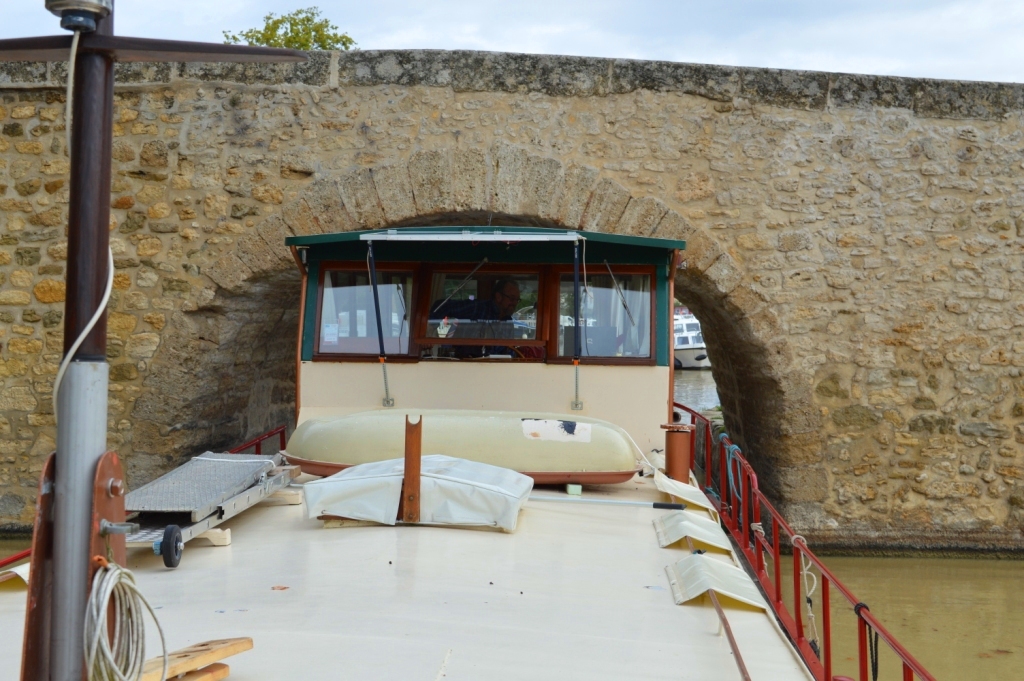
When we set off, we tackled low bridges that caused palpitations. We fudged the drawing of the bridge curves, guessing the water height (after flood rains), and we considered several alternate suggestions from other nomadic-brained cruising folk, such as ourselves:

  1. Load up the boat with passers-by at the feared bridges, offer free beer as an enticement.
  2. Get close to the bridge and ‘GUN-IT-MATE’, which would indeed lower the roof height, as these barges do sink considerably at speed in shallow water (about 3″- 4″)

The problem with these ideas was:

  1. How do I overcome Noel’s inherited Scottish antipathy to providing ‘free beer’?
  2. We didn’t think we had the bottle to approach the offending 200 year old stone arches with 25 tonnes at 6 knots. “What could go wrong?”

We took a day off prior to tackling the low bridges, we had flood rain that night that really ensured the adrenaline reached peak levels…. with clenched teeth and other body parts…we made it – just.

Phew!

Phew!

We made good time south and Noel swam in The Med, he said, “It was very nice, no surf, dead flat and I managed to avoid impaling my feet on the broken glass and syringes.” (I have trouble swimming in the sea, since my shark encounter…another story for another day!)

More recently, we have sacked the planning staff on board that we used on the current co-ordination of events. (Fancy coming so far south for warmer climes to head north again!) There are vacancies in the afore mentioned position. So far, no takers.

Now: The Rewards Each day we trickle along, accompanied by the ripple from our bow. Otters ruffle the silky surface, my favourites, the Kingfishers, flash bright blue and vivid orange within the canal’s banks.

The rewards!

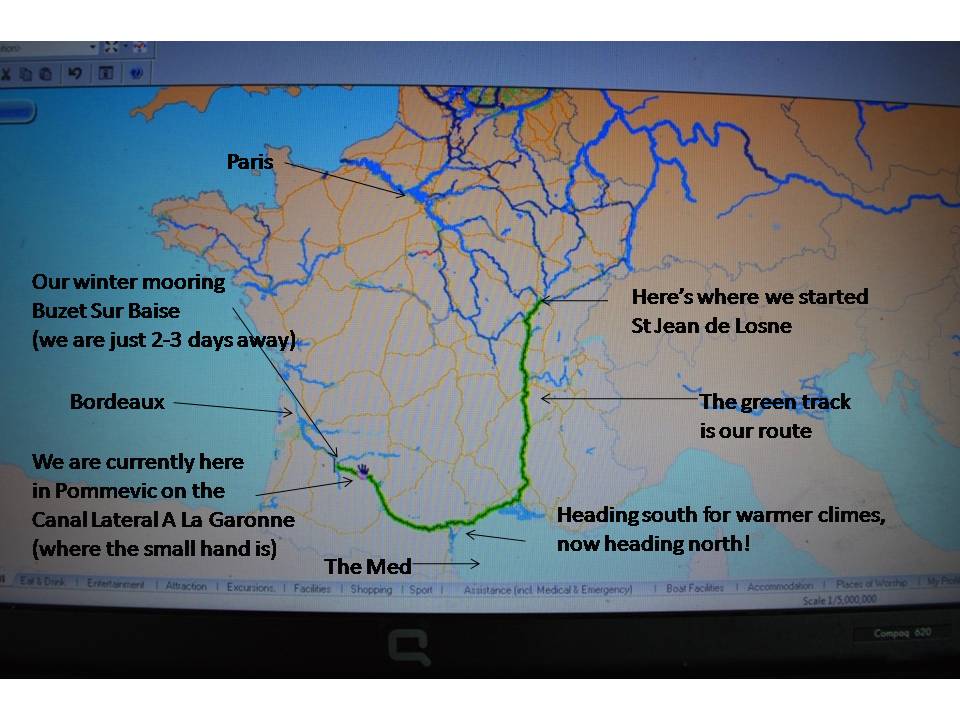
The rewards! Pommevic put on a marvellous display of pink and yellow this morning – (see map below).

It’s a real feast for our eyes, as we putter through villages, rolling hills, and resplendent trees where horses frolic. The relaxed way of travel heightens our senses, the breeze picks up the tangy perfume of autumn, and in the evenings iridescent dragonflies flit in the fading light.

We hear the throaty calls of the dawn chorus, eerily hidden by heavy mist. We are enjoying the cool nights where we feel the pleasure of wearing warm clothes.

Puttering through pretty villages.

Puttering through pretty villages – Moissac.

We’re no longer sailing but we’re still weather watching. Wind is still to be respected and, now, rain too.

The journey is becoming etched on our skin, by way of smiles; created by new friends, passing acquaintances, helpful locals and friendly waves.

It’s been an honour to do this journey and we’re having the time of our lives. It’s all there for the taking, just waiting for us and anyone with a sense of adventure.

The next part of the adventure We plan to renovate below decks and enjoy living in a small, friendly village, Buzet sur Baise. It’s here we’ll re-acquaint with friends that we’ve made along the way, and hopefully make new friends (while creating a nice home too).

DSC_0448

Pommevic is gorgeous – free, safe mooring with electric and water (48 hrs maximum) – so nice, we stayed today!

map

DSC_0453


2 Comments

The Midi, perhaps once isn’t enough…

The two days that inspired my last blog, were just two days. Rude visitors on hire boats made the busy stretch an arduous journey. Our patience was tested to the extreme, but it was just two days!

Shower of autumn golden leaves.

Shower of autumn golden leaves.

In the last two days since, we’ve only seen two hire boats on the move and no other boats whatsoever. The tie ups near the locks are easy, quiet and safe.

The autumn leaves shower down on us as we putter through, burnt oranges, flame reds and deep purples. The ducks still laugh at us as we pass by, the Herons flap lazily across our bow and the otters paddle beneath the dappled light.

Dappled light - stunning

Dappled light – stunning

With great tie up places and crisp, blue days of low humidity; no bumper boats (hire boats) and perfect countryside views, the days are a joy.

Helpful lock-keepers together with helpful public that push the buttons on the automatic locks or catch our lines have made  the last few days perfect.

Perfect days

Perfect days