We are loving Buzet sur Baise. We’ve perfect autumn weather, a safe and quiet port, nice friends just down the road, all within a wonderful quaint village.
With one week of good weather forecast, Noel and I are busily painting the top sides of Rouge Corsair. It’s so easy to forget how hard painting is, this morning every part of my body aches, including my fingers!
Sunday morning we took a break and cycled 5 kilometres (uphill) to a vide-greniers (garage sale). Although it was more like a huge market with just about everything you could ever want – good stuff too.
Image courtesy of federico stevanin at FreeDigitalPhotos.net
Within the bustling, friendly market we met, an Australian, an Irishman and an Englishman, who have invited Noel to play cricket, tennis and go cycling. Noel thought this was rather nice, but did wonder, ‘can’t we just sit under the shade of a tree and drink beer?’
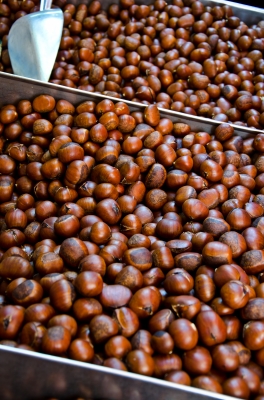
Chestnuts! Image courtesy of jiggoja at FreeDigitalPhotos.net
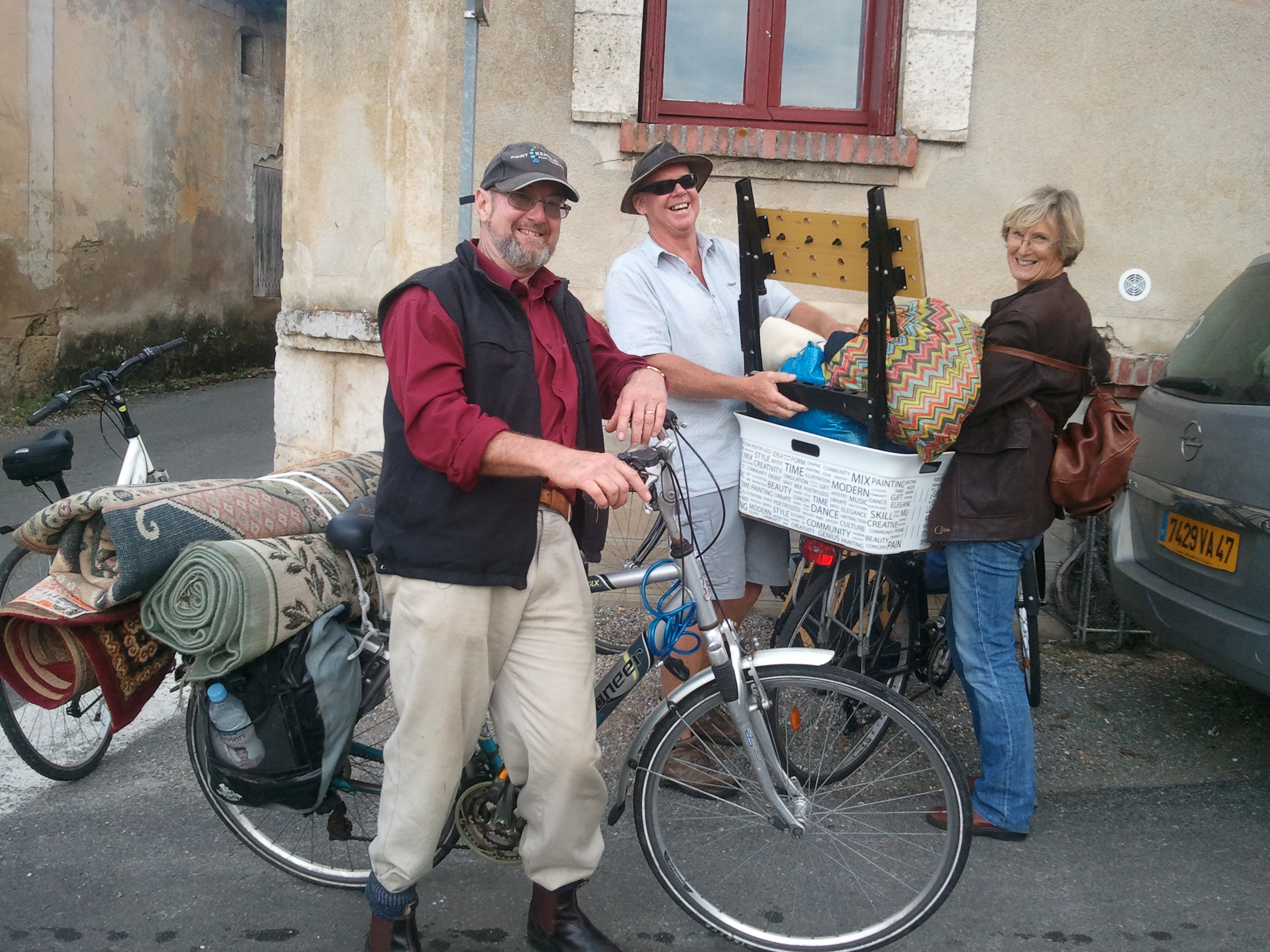
While Noel tried to convince the locals that beer, shade and trees, really was the way to go, I had great fun searching for rugs to insulate our floor for the coming winter, some blankets and bits and pieces. We had great fun with Lorna and Kim from MV Sunflower and a great giggle coming home – thankfully it was downhill!
3 rugs on the back of Noel’s bike, our work-mate bench in Kim’s basket (as well as their stuff) – I had a full back-pack and panniers (as did Noel!)
To find out about the calendar of garage sales, flea markets and flea markets of France, Switzerland and Belgium, dial up: http://vide-greniers.org/
And if ‘coins’ are your thing, look up Richard Lytton. He is a numistatist (and a rather nice chap), www.gascogne-monnaie.com (Australian and world coins).
Buying a boat is just the start of clearing out of your bank accounts. The vacuuming of your wallet will continue if you want to maintain a seaworthy boat. So, how can you save money while cruising?
It’s easier than you think to make savings, there are reams of money saving tips and advice in Cruisers’ AA, here’s a selection to get you started:
AND CRUISERS’ AA WILL BE OUT ON KINDLE NEXT MONTH!
Image courtesy of Salvatore Vuono at FreeDigitalPhotos.net
1) Balance
You need to balance time, money and effort. Invest time in sourcing different prices and quotes for expensive items (sails for instance); but saving a twenty cent bus fare by walking five miles is a waste of time and effort.
2) Boat equipment
Always ask for a discount in a marine store; they are all competitive and will more than likely accommodate you a little.
Good quality equipment can be ‘cheaper’ in the long run, so try to think long-term, especially for the pricier items.
3) Shopping
Buy clothes, shoes, material and tools (if available) in recycling shops; many of these items can be new or nearly new, in great condition and incredibly cheap.
Buy your favourite wines less often, or accustom your palate to cheaper wine. It is amazing what you get used to.
Avoid visiting the touristy shops. Go where the locals shop and eat; you may have to change your diet slightly, but isn’t travelling about new experiences?
4) Health & Well-being
Learn to cut your own hair and your partner’s – it’s easy!
We purchase more expensive sun-cream for our face, brands that do not sting your eyes and are easy to apply. For our bodies we buy cheaper brands, they all work.
For sunburn use cold tea to help reduce the redness and pain.
Drink plenty of water, it helps your body naturally moisturise your skin.
Image courtesy of Ikunl at FreeDigitalPhotos.net
5) Wear & Tear
The key to cruising on a budget is to check your equipment and to make good decisions about how much life it has left. It is tricky when money is tight, but we take time to think about potential purchases and put ourselves in the position of being at sea. If there is bad weather – that expensive item may seem very cheap all of a sudden.
For example, new sails are an expensive item, but well cut sails produce a lot more drive, which reduces how much time a passage will take. Thoughts of our old sails tearing during a 3,000 nautical mile voyage made the purchase a lot easier to swallow.
6) Gifts
Each year, for Christmas, we set a ridiculous budget, such as $5 per person. Recycle shops or local craft stalls are sought and rummaged through. The gift has to be as useful and meaningful as possible.
7) Eating on board/Eating out
Budget cruising means lots of meals on board. This can sound fun or easy, but the reality can become quite different. It does mean work. For two of us, that is six meals a day in total. Including the purchasing of food and the clearing up afterwards, it can feel like a full time job.
Share & prepare: We share the cooking so neither of us gets too bogged down.
Have fun: We do go out occasionally and forget about the budget – we think this is healthy and try not to dwell on it too much.
Balance: How you eat on board is a four-way balance between food availability, your palate, effort and budget. The more effort you put into sourcing reasonably priced supplies and cooking on board for the majority of time, then the less you will spend.
Enjoy the outdoors: If you are out for the day, it does not always mean you have to eat in a restaurant or cafe for lunch. We often buy fresh rolls at the bakery, a couple of bananas and an avocado, and find a nice bench to sit on. More often than not, we have our own water bottles with us and can find a park to enjoy our lunch in.
Eating Out: Limit your dining out to only once a week when in port.
Leftovers: When eating in a restaurant, we always take our leftovers home. I never feel embarrassed about this, it is my meal and I have paid for it. The people in the restaurant are always delighted that we have enjoyed the food so much we want to take it home.
Location, location, location: In a foreign port, eat where the locals eat, not the tourists. It’s usually cheaper and better! Avoid the main street and venture further in to the back streets.
Good meat is expensive in most places. Save your cash by reducing how much meat you eat and enjoy the added benefit of a healthier diet.
8) Make it fun
Declare that for one week there will be no eating out and that everyone must contribute to galley duties, even if it is just meal ideas. New/inspired ideas win rewards at the end of the week. Save money and lead up to the end of the week with a special meal and awards night.
Image courtesy of nirots at FreeDigitalPhotos.net
In summary
Being passionate about everything we do is important to us, including living on a budget. Finding an alternative that is cost effective is very gratifying. Sticking to a budget is not all about missing out; every dollar you save is one less you have to earn. It’s not all about cutting back either; it’s finding a better way to live.
Over time, you will be amazed at how resourceful you become and realise that living on a budget is not repressive; it is actually a fun and exciting challenge. It improves your life and way of thinking. Do not cut corners for necessary equipment and supplies, just prioritise and think about what you actually need, not want.
ANNOUNCEMENT: Cruisers’ AA will be out on Kindle next month!….. follow us at www.jackieparry.com for more details.
As we approach our winter mooring, we’re starting to focus on the next part of our adventure, and look back at what we’ve achieved so far. The journey has been a pleasure and, conversely, a bit like a Carry-On film too. After the ‘challenges’ of buying a boat in a country where we don’t speak the language, we are now reaping the rewards.
First: The challenges Hauling-out, survey and work in a foreign place, with an angry broker (the sellers’ broker) as the sellers had accepted our low offer (our fault?) – AND, secret ‘meetings’ between the yard and previous owners, where we could never figure out what was going on and always felt like we were being led up the garden path to rip-off-land – made a rather stressful time. But, it all worked out in the end – and rather well!
After we’d traversed the buying process, in order to get going Noel spent two-and-a-half days bent over like a crone in the engine room, he fixed umpteen leaks in the wheelhouse windows and we painted a 18.5 metre boat (“why’d you buy something so big?”) – hanging up-side-down to reach the hull or balancing in the leaking dinghy.
Jackie painting (cutting in – NOT fun!)
Meanwhile, a cat adopted us, which was nice until we found out she had at least one other home. We tried to convince the cat to go home and stopped feeding her, but there was a bountiful supply of field mice. The cat stayed and continued to leave a trail of gall bladders on the carpet and mats to denote her preferred nocturnal eating spots.
Lily sleeping!
When we set off, we tackled low bridges that caused palpitations. We fudged the drawing of the bridge curves, guessing the water height (after flood rains), and we considered several alternate suggestions from other nomadic-brained cruising folk, such as ourselves:
Load up the boat with passers-by at the feared bridges, offer free beer as an enticement.
Get close to the bridge and ‘GUN-IT-MATE’, which would indeed lower the roof height, as these barges do sink considerably at speed in shallow water (about 3″- 4″)
The problem with these ideas was:
How do I overcome Noel’s inherited Scottish antipathy to providing ‘free beer’?
We didn’t think we had the bottle to approach the offending 200 year old stone arches with 25 tonnes at 6 knots. “What could go wrong?”
We took a day off prior to tackling the low bridges, we had flood rain that night that really ensured the adrenaline reached peak levels…. with clenched teeth and other body parts…we made it – just.
Phew!
We made good time south and Noel swam in The Med, he said, “It was very nice, no surf, dead flat and I managed to avoid impaling my feet on the broken glass and syringes.” (I have trouble swimming in the sea, since my shark encounter…another story for another day!)
More recently, we have sacked the planning staff on board that we used on the current co-ordination of events. (Fancy coming so far south for warmer climes to head north again!) There are vacancies in the afore mentioned position. So far, no takers.
Now: The Rewards Each day we trickle along, accompanied by the ripple from our bow. Otters ruffle the silky surface, my favourites, the Kingfishers, flash bright blue and vivid orange within the canal’s banks.
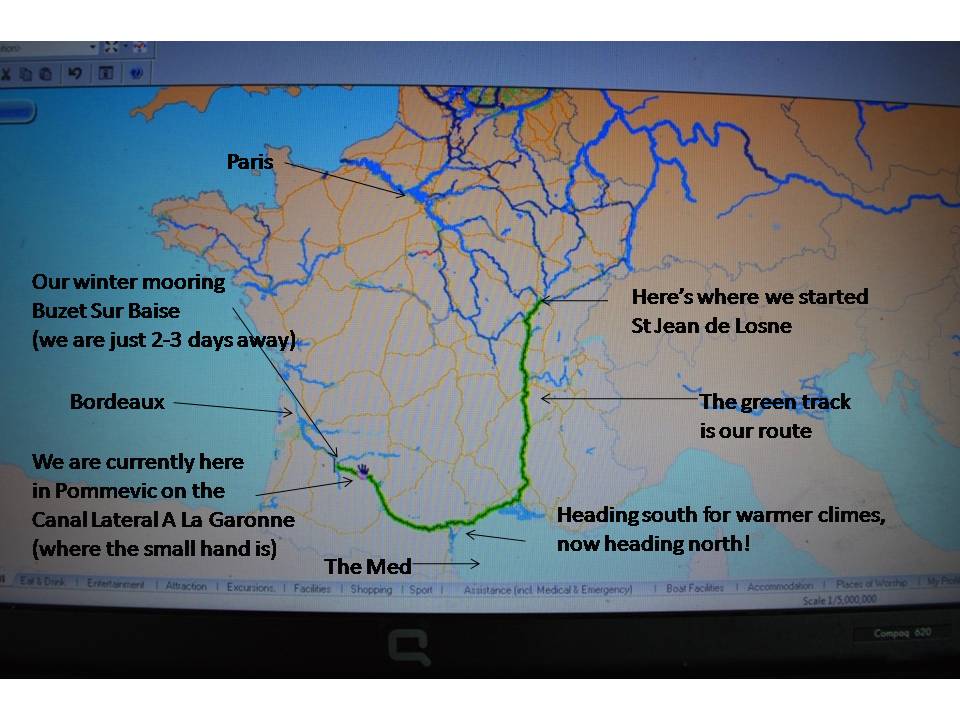
The rewards! Pommevic put on a marvellous display of pink and yellow this morning – (see map below).
It’s a real feast for our eyes, as we putter through villages, rolling hills, and resplendent trees where horses frolic. The relaxed way of travel heightens our senses, the breeze picks up the tangy perfume of autumn, and in the evenings iridescent dragonflies flit in the fading light.
We hear the throaty calls of the dawn chorus, eerily hidden by heavy mist. We are enjoying the cool nights where we feel the pleasure of wearing warm clothes.
Puttering through pretty villages – Moissac.
We’re no longer sailing but we’re still weather watching. Wind is still to be respected and, now, rain too.
The journey is becoming etched on our skin, by way of smiles; created by new friends, passing acquaintances, helpful locals and friendly waves.
It’s been an honour to do this journey and we’re having the time of our lives. It’s all there for the taking, just waiting for us and anyone with a sense of adventure.
The next part of the adventure We plan to renovate below decks and enjoy living in a small, friendly village, Buzet sur Baise. It’s here we’ll re-acquaint with friends that we’ve made along the way, and hopefully make new friends (while creating a nice home too).
Pommevic is gorgeous – free, safe mooring with electric and water (48 hrs maximum) – so nice, we stayed today!
The two days that inspired my last blog, were just two days. Rude visitors on hire boats made the busy stretch an arduous journey. Our patience was tested to the extreme, but it was just two days!
Shower of autumn golden leaves.
In the last two days since, we’ve only seen two hire boats on the move and no other boats whatsoever. The tie ups near the locks are easy, quiet and safe.
The autumn leaves shower down on us as we putter through, burnt oranges, flame reds and deep purples. The ducks still laugh at us as we pass by, the Herons flap lazily across our bow and the otters paddle beneath the dappled light.
Dappled light – stunning
With great tie up places and crisp, blue days of low humidity; no bumper boats (hire boats) and perfect countryside views, the days are a joy.
Helpful lock-keepers together with helpful public that push the buttons on the automatic locks or catch our lines have made the last few days perfect.
Well? Tell me? Yes, yes, they are probably more sensible and have NOT come to the Canal du Midi in peak season.
Peak season? I thought we were safe after August. How little do we know! But we have not seen ONE OTHER barge on the move (except a hotel barge).
We travelled through a system of 6 locks with these two boats. We let them over-take us on the canal – then they wouldn’t let us in the next lock!
There are mobs and mobs of hire boats, a whole gaggle of them. Great, lovely….. some of them are. Others are rude, obnoxious, block the locks and worse have NO IDEA where a boat’s pivot point is!
At the helm , they assume they are in a car, so astern propulsion (yes, astern propulsion, not reverse)…. is incredibly exciting to watch and completely terrifying if you are any-where near the ‘helms-person.’
The wash keeps boats apart.
I know, the old hands here (less of the old please!) will have heard and suffered this before. But for us it is an eye opener. Thirteen years ago I don’t remember having this trouble, I thought people had less money for holidays now, not more.
Oh, I know, it is the Midi. Someone wrote a book once about sailing the Red Sea, they called it, ‘Once Is Enough.’ I may do a 5th book, (yes there are more to come), about The Midi, as beautiful as it is, ‘Once is Enough!’
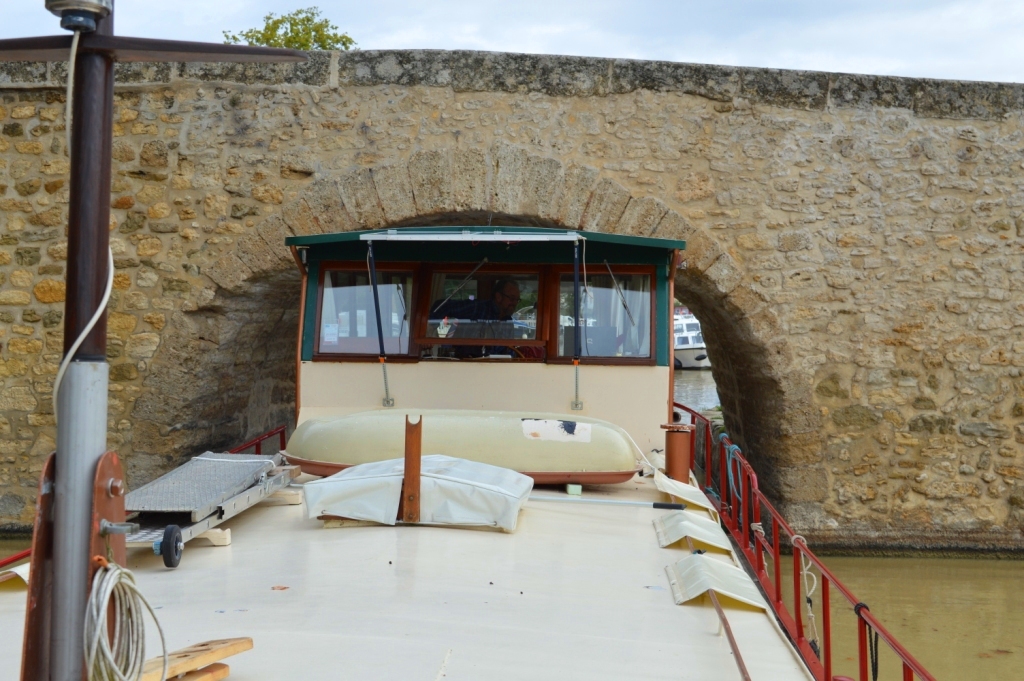
It had rained for two nights a bought flood waters. So, of course, we decided to tackle one of the lowest bridges: The Capestang.
Not helping by raising the water levels and decreasing our likelihood of getting under the bridge.
It’s not so much that it is low, but the curved arch reduces the height dramatically, the wider the boat.
Brilliant!
We inspected the bridge, and there is not one inch of it that hasn’t already been gouged-out by previous boats. More rain was forecast, we had to have a go.
Really?
With sweaty palms and flip-flopping stomachs we puttered up to the bridge. The game plan? I was on the bow indicating centre – then watching the stern and pointing in the direction the stern needed to shift to keep us in the centre.
Flip-flop, flip-flop (my stomach!)
If we scratched the paint we didn’t care. We went that slow, we could stop, reverse out and go back to our mooring with nothing more than our ego damaged.
My cool cucumber!
Noel, as usual, was great on the helm and cool as a cucumber. I matched his coolness on the exterior but inside my stomach was making its way up to my throat.
Phew!
With an inch gap each side of our wheelhouse roof we glided under and it was then that I remembered to breath – we made it!
Farewell to the lovely village of Capestang, and Jane (fellow WOB – Women on Barge member (FB)), (and John and Sophie), hope to see you again when we’re heading north!
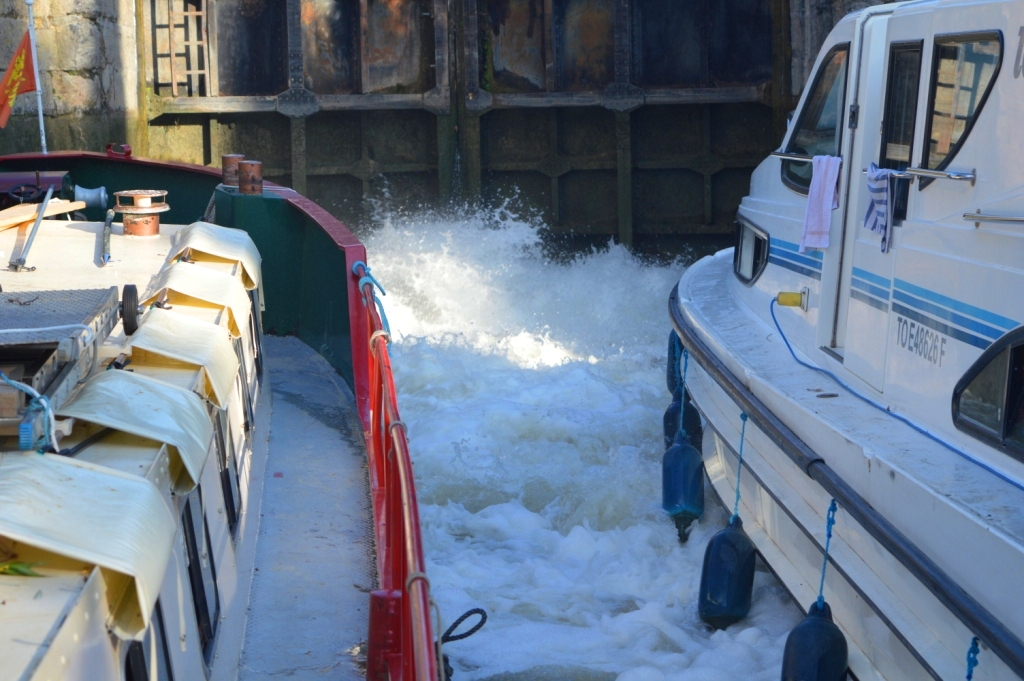
But we did make it. Ecluse number 56 de Fonseranes (K206.5), has six locks, one after the other. Fortunately, we were first in line, but two other boats where squished in with us, testing everyone’s skills and patience.
At the first lock, the lock-keeper swaggered over and managed to stop chatting on his mobile for a second. I naturally assumed he had come to take my line (as per every other lock-keeper). He took the line, slipped it over a bollard and then rapidly shot fast-French at me, ignoring my pleas to slow down. His disgust at handling our lines was evident.
He chatted on his phone more, watched the other boats come in and then said, in near perfect English, ‘you do your own lines.’
‘Of course,’ I said, ‘No problem.’
To which he replied with the most magnificent Gaelic shrug, that I would assume is usually reserved for vermin.
This was before they REALLY let the water in.
The hire boat was ordered to leave the first lock, first. While the crew gathered the lines the lock-keeper tutted, rolled his eyes and stood with hands on hips. Who knows what was going on in his tiny mind – but the phone rang and it was all smiles and back to chatting with buddies.
As we puttered in I wondered how I was going to get the lines on the bollards with the boat-hook, the lock walls were too high.
‘About a third-of-the-way-in are steps,’ I said to Noel, ‘You’ll have to get me near them.’ Noel nodded in his usual relaxed manor.
I’d climbed up many locks before in our sailboat. I know it is ‘not the done thing’, but we had no choice back then or here. Back then I was on a low boat, with no lock-keeper I had to get the lines on a bollard, so up I went. Here, with muscles some thirteen years older, I had to think carefully about what I was doing.
The dry steps, of course, the lower ones were underwater and covered in green slime.
I took my time but it was a little scary.
You could walk the boat through (and others did, keeping hold of the lines) but they had plenty of crew, shorter boats, lighter lines. But, they still couldn’t ‘walk the boat through’ when we all got to the bridge. Besides Noel was doing inch-by-inch manoeuvring (handled brilliantly), and I wanted to help him too.
What followed was a scary launch of my body out to the slippery, slime-ridden steps, a steady climb with a fore and aft line on each shoulder and crowd-pleasing success. Noel manoeuvred the boat’s bow and stern right up close to the wall, however the curved lock-wall still meant I had large leap. I received ‘whoops’, claps and admiration. Meanwhile, the lock-keeper straightened his sunnies and chatted on the phone.
There was plenty of cheering as I made my way up.
What resulted was me feeling alive, working the ropes, being independent, and being strong. I was thinking on my feet. On this trip, we’ve been hauling anchors, furling heavy ropes several times a day, climbing on deck, jumping ashore and shopping via bicycles. My muscles are becoming defined, my jeans are looser, I feel alive and yes, I am loving the whole thing!
The other amusing result I’ve noticed is that our precious paint is no longer precious. After six locks in what can only be described as ‘water-fall’ conditions, just inches (sometimes much less) between boats and walls, and all of a sudden you don’t give a flying fig about your paintwork – just surviving unscathed!
The climb.
In my opinion, as lock-keepers, there’s too much responsibility for surly youths, which results in an attitude. That said, apparently since their hazard pay has been taken away, the lock-keepers on the Midi will not take your lines. I am not sure what the hazard is of taking lines. Actually it created a hazard as we took a moment or two than usual to secure the boat, and the lock-keeper let the water in before we were ready! Not fun!
I noticed, also, that not one of the boats’ crew looked at, waved, said Merci or even acknowledged the lock-keepers.
Fanfare if you please, we’ve made it to the Canal du Midi.
Entering the Canal du Midi
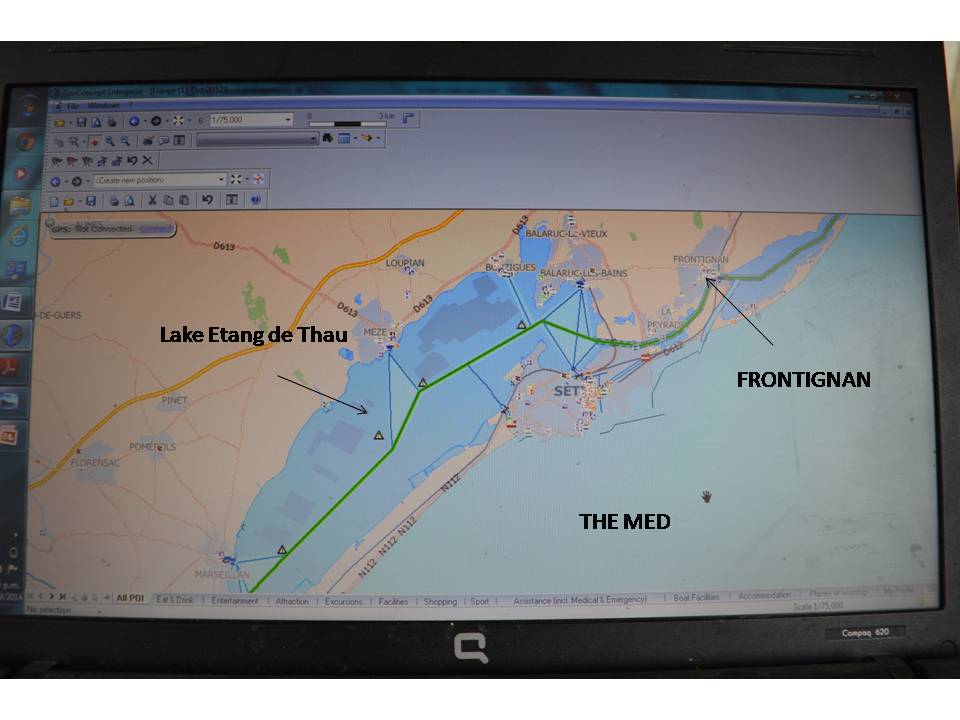
Lake Etang de Thau was welcoming in its expanse. It was nice to see a long watery horizon. We had perfect conditions, the sun bounced off the silken water and reflected the cloudless blue sky.
About to enter the lake, prior to reaching the Midi
Lake Etang de Thau. It is illegal to traverse this lake in winds in above Beaufort scale 3, (7 to 10 knots).
The Midi has presented its own challenges, round locks, shallow depths, narrow stretches and low bridges. It’s had our adrenaline up at times, it’s tested our boat handling skills and we’ve loved every minute.
Squeezing under bridges, there are lower ones to come!
Rouge Corsair’s fine bow, slicing through the water.
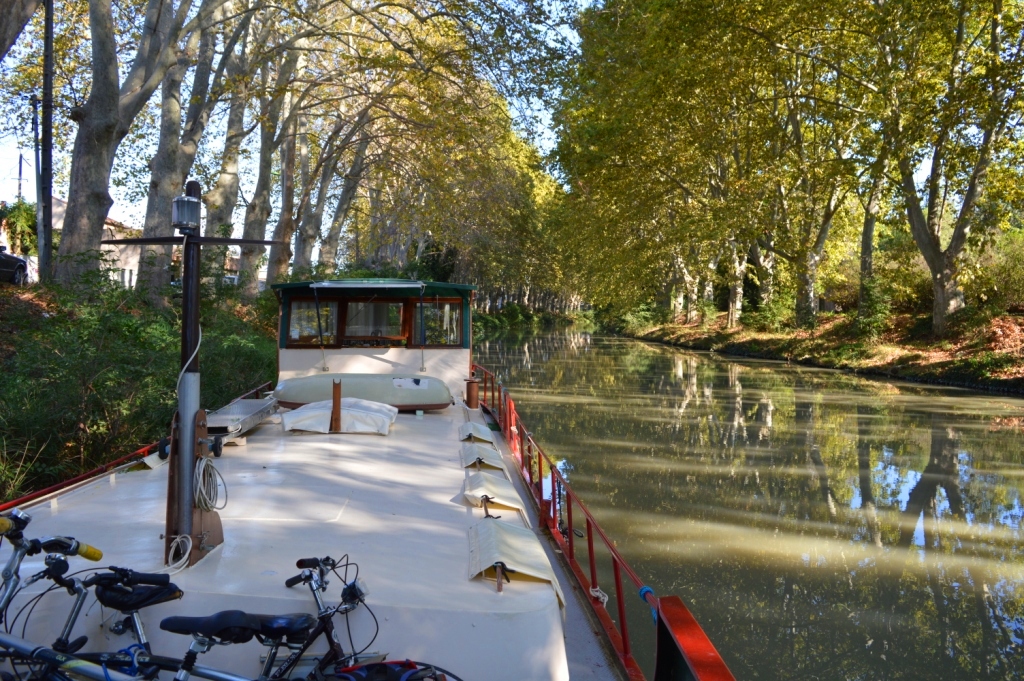
Many plane trees are still left, but more are sadly marked for cutting down. But there’s hope that the beauty will be restored with new trees lining parts of the canal.
The beautiful trees are still in abundance… our first mooring in the Midi – just heavenly.
Frontignan – our last stop before crossing the Lake.
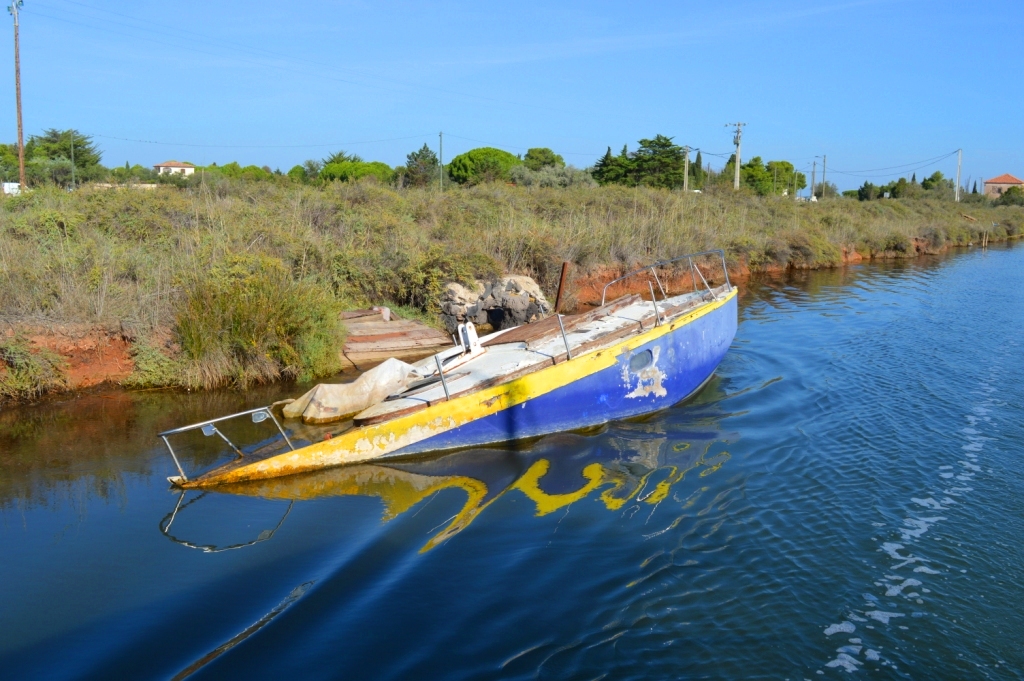
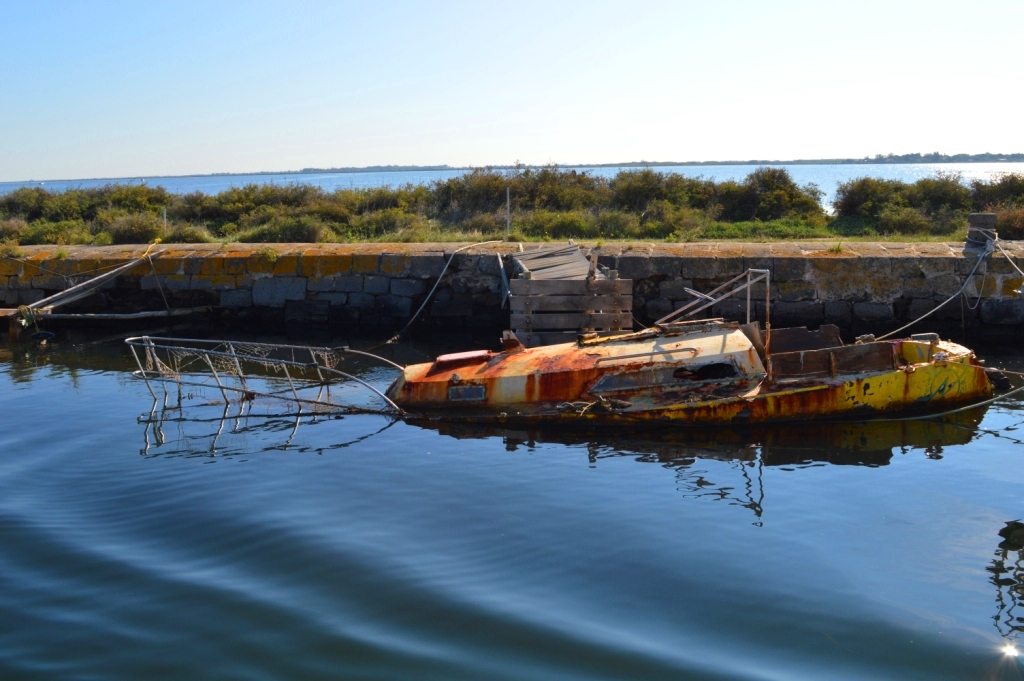
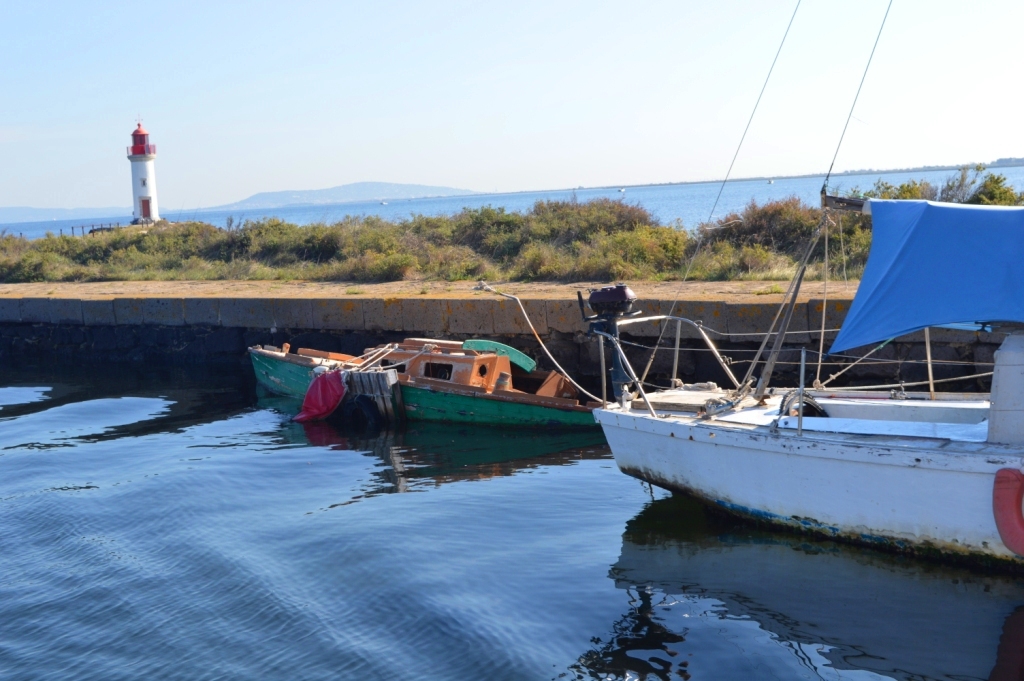
The startling array of sunken boats as we entered the Midi was quite astonishing. These few, in the pictures, were in a stretch of half a kilometre, and I didn’t photograph them all… so sad to see…
We’re in south France. Rouge Corsair is galloping along and we can’t quite believe we are down near the Med already.
Gallician – moored on the bank, just a short stroll from the pretty village.
It smells different here. The salt air is refreshing, the Medittranean breeze is cooling. The dry grass is a contrast to the lush paddocks that we saw in the middle of France, but the harshness of the land reminds us of Australia – where things sting and stick-in you!
Gallician location – on the Canal du Rhone a Sete
We’ve made good time, enjoying the scenery pass us by is a heavenly way of viewing France. The friendly waves, the great (free) tie up places and the fun boat people from all over the world keep us smiling all day.
We love not having a car to worry about and pay for. Freedom is a moving boat and two bicycles.
Work doesn’t stop for boats, we all had to squeeze between the floating bollards and the crane!
The midi is approaching and that’ll be breaking new ground for us.
I didn’t talk to my husband for two days when his peculiar answers to my naïve nautical questions reached my bewildered ears. Back then, as a mere fledgling to sailing, my raw researching met brutal honesty. Seeking a sailboat and home, to travel the planet, I tried to grasp the financials and what, exactly, was I letting myself in for.
“How much does it cost to buy and then maintain a boat?” Coming from the corporate world I was gearing up to write in-depth project and budget plans, but abruptly shook those thoughts from my organised head when Noel replied.
“It’ll take every penny we have.”
“Oh right, well, what’s so great about sailing?” Expecting to be assailed with vivid pictures of slicing, splendidly through clear, flat water, with handsome palm trees and white sandy beaches supplying a dreamlike backdrop, the image shattered as Noel’s ruthless reply tore through my reverie,
“Getting to port,” he said, “and the local bar”.
Seven years later and over 40,000 miles clocked, I can see the wisdom in his answers.
Getting into port is one of the best bits! Daniel’s Bay, Marquesas.
Enduring the Escapade
Long term cruising is an incredible adventure and hard work. Arriving in a new country or town, our thoughts steer to, how do we check in? Where do we get fuel and potable water? How much is it?
The men talk amps and engines the girls talk laundry and supermarkets. Noel, Mariah and I are on our last leg in the superb south Pacific Ocean. Aside from reflecting on our magnificent voyage so far, a few ludicrous “learning’s” deserve a mention.
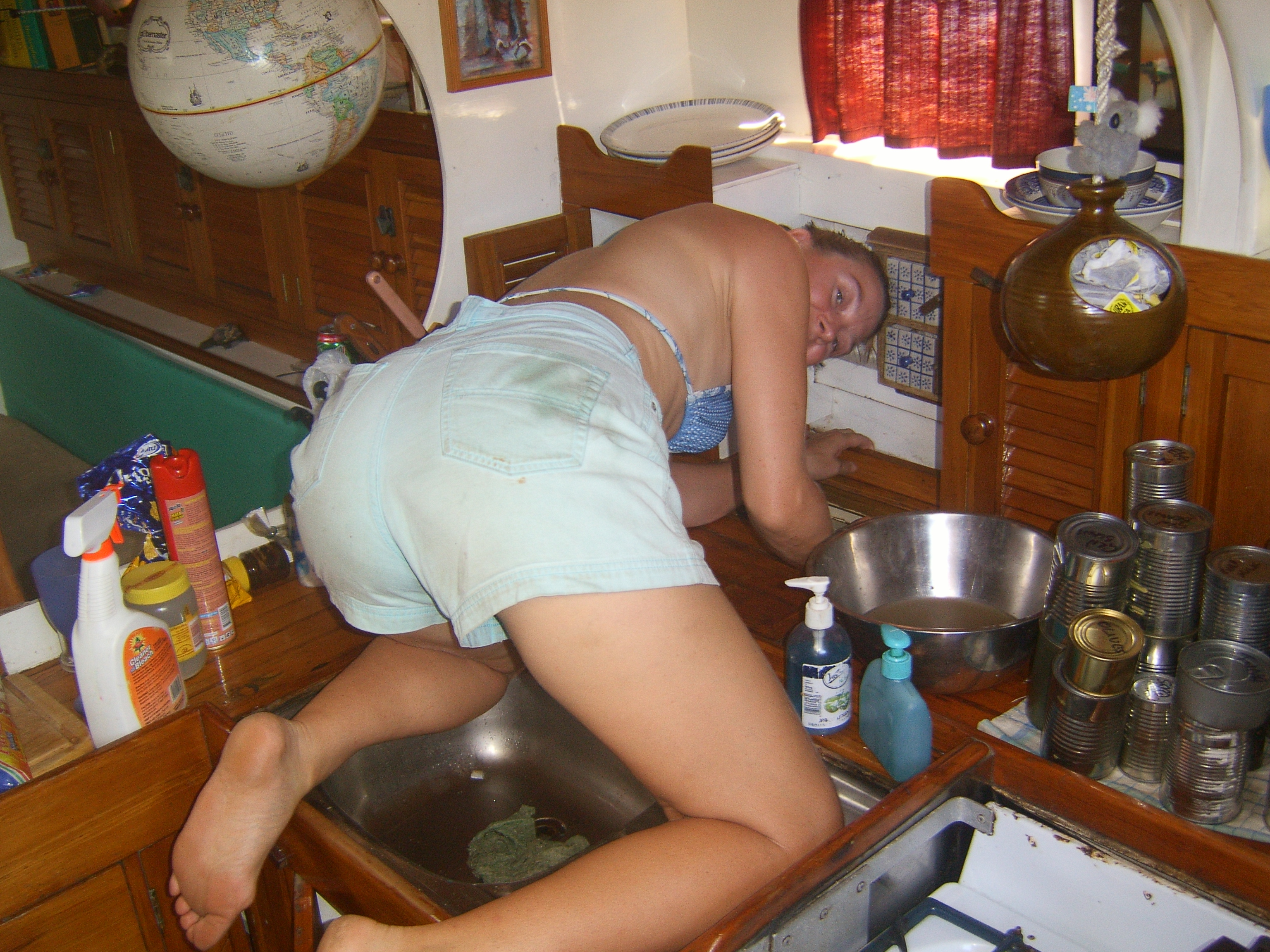
Cleaning cupboards reality – it is not your ‘average’ kitchen.
First, let’s be positive. Our escapade divorces and insulates us from the world’s day-to-day problems. We are not ashamed to bury our heads in the sand and enjoy the “ignorance is bliss” scenario, while we can. News never changes; it is sad and depressing today and tomorrow.
Frequently we meet like-minded people, of all nationalities, where age is no friendship barrier. Hooking up with similar sized boats and sharing the ocean brings the comfort of companionship and the joy in sharing the dolphins that play on our bow during those perfect sailing days.
Mostly, for us, it is the freedom of living simply. We have no letterbox where small bits of paper with large numbers intrude into our sanctuary, sucking dry the bank account to allow landlubber luxuries. And yes, there is the odd G & T (Vodka for me please) while watching spectacular sunsets, doing an anchor pirouette, savouring the sedate, shifting views as we would fine wine.
Secrets of the initiated
Over the year’s advice, hints and tips have deluged our salt saturated minds until our armpits are all but overflowing. We thought we’d heard it all, but here are some unmentionables that we learned along the way:
(1) Constipation – the most fluid of us struggle on long trips. On watch, the comfy cockpit seat will become well acquainted with your behind, causing, what we refer to as – the cork effect.
(2) Seasickness – the toughest of us will become seasick. After corkscrewing for 48 hours solid, your tummy will give up all hope of hanging onto to anything. Most of us unwillingly feed the fish at some point. It is like puberty, you just have to get through it. Despite suicidal thoughts during the worst bouts of seasickness, once you have reached your haven and spent a few days in flat water, going back out into lumpy seas suddenly becomes a good idea again. On the plus side it is a great diet!
(3) Toilet tantrums – at some point most marine toilets will block. If you have not been allocated the repair task, leave the boat while it is being fixed. Build up of pressure while trying to pump it clear will create the most spectacular explosion. Becoming AWOL at this time will help avoid a good dose of (5).
(4) Landlubbers – your farewell from home will be tearful, exciting and filled with unfulfilled promises from friends and family, who assure you that they will keep you up to date on home happenings. After two years you will be grateful for an email once every six months from your bestest buddies, all of which think you spend your entire life sitting on the aft deck sipping G & T.
G&T on the aft deck – after this I’d need one.
(5) Arguments – the closest relationship will suffer at times. Falling out with your spouse is inevitable especially when you are woken three and a half minutes before you are due on watch at 3 am. Learn to talk about it and laugh, it can get damn lonely otherwise and create a yearning for (4).
(6) Moon-fright – the moon is crafty bugger. You know it is due to rise, but as you scan the horizon there is a luminous light that assumes the shape of an approaching aircraft carrier. This will be the moon, strategically cloaked with black cloud to form heart-stopping shapes. However, the moon will become your buddy, especially if dealing with number (5).
(7) Cravings – two days out of a long haul sail you will desperately desire all those things you haven’t got. Roast chicken, ice cream…
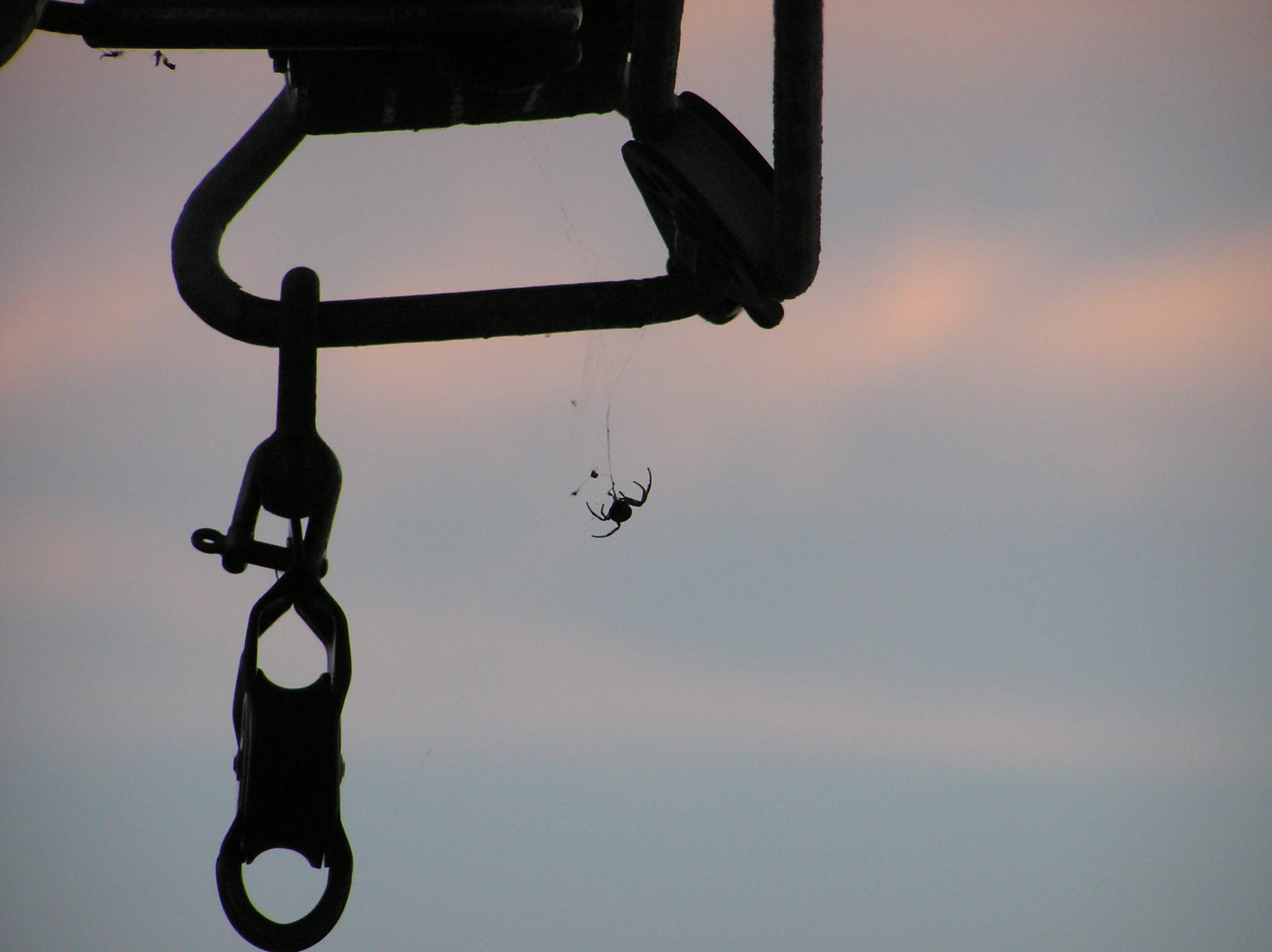
(8) Spiders – having abhorrence to the skittering critters my husband assured me that life on board meant no spiders. This seems reasonable, after all we are away from land a lot of the time. Reality is that I am sure we have had a hand inter breeding crawly critters from different countries, probably creating a whole new weird and wonderful breed.
(9) Time – boat maintenance is a full time job in addition to washing, cleaning and sourcing supplies. If you are fortunate enough to momentarily catch up, items (1) or (2) – or both if you are unlucky, will fill the gaps. At the end of each day you’ll just have time to read a page or two of that book you’ve always wanted to read, before sparking out.
(10) Fishing – you will fish once per trip. After you have heaved the huge dolphin fish on board and it has thrashed itself to death, splattering blood over the clean, white cockpit and your battle weary body, the fishing gear will gather salt in the Lazorette for the rest of the journey. By the next trip, you will have forgotten the sticky mess and break out the lines.
(11) Sinking – on your watch, typically in the graveyard hours, you’ll check the bilge for the last time before the welcome warmth of bed and the bilge will be full of water. Instantaneously you are wide-awake and have no problem in screeching at your partner who is obviously having their best ever sleep. Turning the mains off is not an option and two hours later you will find the solution to the problem is something as simple as greasing the stern gland. Finally, you’ll crawl into bed and the stampeding adrenaline will keep you awake until twenty minutes before you are due back on watch.
(12) Plip-plop – you will loose something overboard, deal with it, it is gone.
(13) Fitness – you will not become fit sailing. Although you do become trim, see (2).
(14) Turning back – face facts that the storm you can no longer punch into has beaten you. It is not failure to turn back, it is common sense and above all the boat’s and your safety – also helps relieve item (2).
Fixing a sheared pin in an exotic place (Tahiti).
(15) On a long passage – when the fresh food has all gone (and if you are like us, without fridge) after a week tinned food will taste all the same. It will have that unmistakable metallic flavour (tinny flavouring assists number (2)).
(16) Dust – dust will collect with intensity, especially in those tiny, boat shape, awkward places. Adds to (9).
(17) Company – your partner is only ten feet away sleeping below, at that time you are single-handing. It can be lonely, maybe a good thing if dealing with (1), (2) or (5)!
(18) Plunging – on moonless nights you plunge into thick darkness, with peripheral vision coming to a shocking end at the bow. It’s best not to dwell on this too much.
(19) Meteorites – the dark nights are abundant with “shooting stars”, but watch for the big ones. Out of nowhere, a spot light will beam down on you while you sit quietly in the cockpit minding your own business. A huge, bright meteorite will give you occasion to create a few more grey hairs.
(20) Advice – some will be good and some, well, let’s just say, some will be totally fictitious. You will meet some gold medal winning “know it alls”, for example this article, is it fact or fiction? – best way is to get out there and find out for yourself.
Coming into glorious destinations, like the Bahamas, you can never sit back and relax.
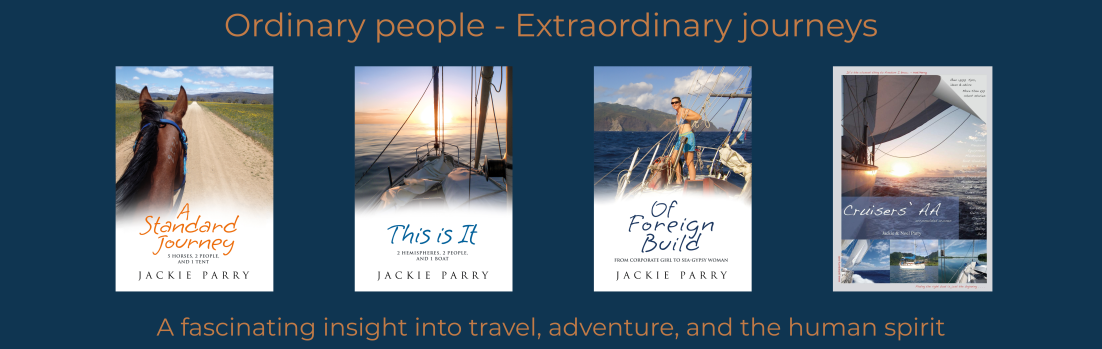
For lots more great tips, tricks, ideas and advice on living on board, see our book Cruisers’ AA.


























 Jackie Parry - author